




Enjoying winter hiking safely
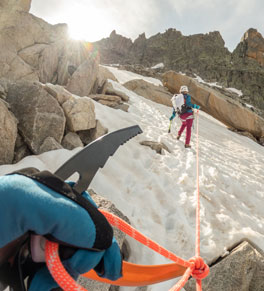
A mountain trail covered in snow presents a completely different challenge than the same dry trail does in other seasons.
The addition of snow and ice significantly increases the risk of injury or death.
Nearly every year, people die while hiking Southern California mountains as a result of a failure to prepare, and most importantly, a failure to recognize when to turn back — or not go at all.
Whenever you head out on a trek, it is essential to check the weather. And not just the weather outside your window.
Know the forecast
Check current weather conditions for the specific location you plan to visit as well as the forecast for the duration of your hike.
Weather conditions on any given day can vary significantly throughout our region. Mountainous areas may be colder and have snow when lower elevations nearby have had no rain at all.
Many Southern California mountain ranges have towering, often snow-capped peaks, like the 10,064-foot Mount San Antonio, also known as Mount Baldy, and the 11,503-foot Mount San Gorgonio, aka Old Greyback.
Online sites such as Mountain-Forecast can give up-to-date information for a range of elevations for areas across the country.
If a storm is expected to blow through within 12 hours of your planned trip, consider delaying until calmer conditions are forecast.
Know the terrain
Snow and ice on moderate- or even low-angle slopes significantly heightens the risk of slipping or falling.
Moreover, snow drifts can obscure the trail, itself. On a narrow ridgeline such as Mount Baldy's Devil’s Backbone, where three hikers perished recently, one can easily slip or stumble and fall hundreds of feet.
Snow also melts then refreezes, creating dangerously slippery conditions.
Sticking to areas with lower-risk flat terrain can allow everyone to enjoy a stress-free day in a winter wonderland.
Proper clothing counts
Given that the temperature and your exertion level may change significantly while you are outside, dressing in layers is key.
Although most of us wear cotton daily, the phrase “cotton kills” is used by outdoor enthusiasts for a reason: Cotton can absorb moisture from sweat, in addition to rain and water. It also takes a very long time to dry, especially in cold weather. That wet layer of clothing next to your skin accelerates heat loss, which could lead to life-threatening hypothermia.
Instead, your outfit should consist of a:
- Base layer made of wool or synthetic materials. Its purpose is to wick moisture away from your body.
- Layer of insulation made of wool, fleece or down. This layer can also be multiple pieces of clothing you can adjusted as the temperature or your exertion level change. Clothing should fit loosely for better insulation and easier layering.
- Shell, or outer layer, made of wind- and water-resistant material. This helps prevent heat loss from exposure to wind and water.
You should also bring:
- A buff or ring of cloth to cover your mouth and protect your lungs from harsh, cold air at high elevations
- A hat with insulation and a brim for shade
- Mittens or gloves
- A scarf or neck warmer
- Polarized sunglasses to protect your eyes from snow blindness
Food and safety supplies
Always carry enough water and snacks for 24 hours in case you lose your way, get or are injured and there is a delay before rescuers can find and reach you. This is true for mountain hiking in any weather.
Your pack should also have:
- Basic bandages and moleskin for blisters
- An emergency bivy sack, a waterproof bag to help you stay warm should you get lost or injured
- A flashlight with a strobe setting to make it easier for a rescue helicopter crew to locate you
- A physical map of the area — no battery or wireless signal necessary
- Any medications you may need
- A pocket multitool with a small knife, be essential for problem-solving on the go
If you choose to bring fire-starting materials for an emergency, be mindful of the region’s fire danger.
How are you going to carry this stuff? A comfortable, adjustable backpack is essential.
The right safety equipment
When hiking in areas of moderate or high-angle terrain, microspikes and walking sticks used in dry conditions are never sufficient safety equipment for winter trekking.
In snowy conditions, dedicated crampons with compatible boots and an ice axe are essential.
It is also vital to learn how to use these tools and practice self-arrest techniques on low-angle trails with snow and ice before you consider venturing into more challenging terrain.
Never separate
After assessing multiple fatal mountain events over the years, it is evident that the most important decision hikers and mountaineers can make is knowing when to turn around.
When a group hasn’t agreed beforehand on the criteria for changing course, some in the party may continue forward while others turn back. The decision to separate often becomes a fatal one, as it did for one hiker recently on Mount Whitney
Honoring the plan to stay together can save more lives than all of the fancy gear you could fit in your pack. Remember: The summit is optional. The parking lot is mandatory.
Tell others your plans
Inform your friends and family about your upcoming plans. Tell them where you are going and what time you expect to return.
This way, if you have an emergency and are unable to establish communication with 911, your loved ones can alert authorities that you are overdue and provide them with the general area to start search-and-rescue efforts.
Summoning help
In an emergency that requires rescue, personal locator beacons (PLBs) and other satellite messaging devices provide emergency personnel with the most accurate location within 100 meters.
These handheld devices with five-year batteries can, with the push of a button, transmit your location via satellite to local emergency personnel.
Commercial satellite messaging devices can also summon emergency personnel. In addition, they can send messages and have other nonemergency communication features, including allowing loved ones to track your location.
The limits of cell phones
It is true that some newer cellular phones come equipped with emergency satellite notification features.
However, while your phone may be an option in a crisis, two significant limitations exist.
First, your phone will do you no good if the battery is dead. Always head out with a fully powered battery and turn off your phone until you need it to prevent roaming signals from draining the charge. A battery extender can also help.
Second, triangulating your phone’s location is less accurate when there are fewer nearby cellular signal towers. The calculated location sent to 911 of a cell phone in a wilderness area is far less accurate than one in a suburban or urban environment, complicating any rescue operation.
Hopefully, this information will provide you with helpful knowledge about how to explore our wilderness safely.
We are fortunate to be surrounded by wild lands of phenomenal beauty and recreational potential. Find a new spot to explore. Plan your trip and gather your equipment. Then head out and enjoy all that the Southern California wilderness has to offer!
Dr. Robert J. Katzer is a UCI Health emergency medicine physician and a professor in the UC Irvine School of Medicine’s Department of Emergency Medicine. The assistant director of the department's Wilderness Medicine Fellowship program, Katzer also teaches wilderness medicine to medical students and residents.