




Novel ALS therapy a 'game-changer' for artist
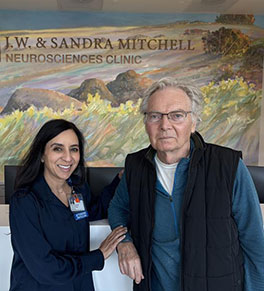
Painter and illustrator David Luce has seen firsthand how amyotrophic lateral sclerosis, also known as Lou Gehrig's disease, can change a person’s life.
He watched his father and sister fight a losing battle with the progressive neurodegenerative disorder in the early 2000s.
He hoped that he wouldn’t develop the incurable disease, which can be hereditary.
But in 2020, Luce felt a twitch in his right leg while practicing yoga.
Within several weeks, the twitch progressed to cramps on his right side and in his quadriceps. Soon he was walking with a limp and needed a cane to get around at home.
The retired art professor knew something wasn’t right with his body and sought answers. After a myriad of tests, Luce was officially diagnosed with amyotrophic lateral sclerosis (ALS) in 2021. Tests showed that his was the same type his sister had.
This rarer form of the disease involves a mutation of the gene called superoxide dismutase 1 (SOD1). About 10% to 20% of patients with inherited ALS have SOD1-ALS, but it occurs in just 1% to 2% of people diagnosed with sporadic ALS.
Novel treatments studied
While there is no cure for ALS, which destroys motor neurons in the brain and spinal cord, drug therapies have emerged that may slow disease progression. Luce was elated to learn that one such promising investigational drug, called tofersen, was developed specifically for SOD1-ALS.
“Once I was diagnosed, I learned about new ALS clinical trials, which weren’t in place when my father and sister were diagnosed almost 20 years ago,” he says.
“I heard about the drug, tofersen, which was slowing progression of SOD1-ALS in clinical trials. UCI Health was one of the few places in Southern California at that time with access to this treatment.”
Luce contacted UCI Health and was referred to neurologist Dr. Namita Goyal, director of the UCI Health ALS & Neuromuscular Center, one of the leading ALS programs in the region.
She and her team applied to get him special access to be treated with tofersen before the drug had been approved by the U.S. Food and Drug Administration (FDA).
Early intervention
Within 90 days of contacting Goyal, Luce received his first injection of the drug into his spinal fluid on March 1, 2022.
“We have found that administering novel treatments early helps to slow the progression of this disease,” says Goyal. “That’s why it’s so important to continue to fund cutting-edge research — it gives patients and their families hope.”
Within about six months, Luce began to experience improvement in muscle control and movement. He no longer needed to use a cane when walking at home.
He credits this to the drug therapy, but also to his wife, a physical therapist who encouraged him to continue regular yoga exercises and Pilates sessions.
Game-changing results
The FDA eventually approved tofersen for use in patients with SOD1-ALS in 2023. A recent study of the drug showed that about 25% of patients saw their symptoms stabilize, along with improvements in grip strength and respiratory function.
Now, four years and more than 45 spinal injections later, Luce’s ALS symptoms have not progressed beyond his right leg. He does rely on a walker when he leaves his house. But that, he says, may also be due to the fact that he's 76.
He is grateful to be able to continue painting and he also enjoys spending time with his wife.
“Tofersen is truly a game changer,” Luce says. “I am incredibly thankful for Dr. Goyal and the care I’ve received at UCI Health.
“There is hope, even with a terminal diagnosis.”
Exciting times in ALS research
Goyal, who is delighted by Luce’s progress, says she and her team have treated a number of patients with tofersen, some of whom have experienced similar results. She’s especially eager to learn more about tofersen's effects and whether the science shows it can be applied to all ALS patients.
“This is an exciting time for ALS researchers," she says. "We continue working to discover novel ways that may extend the lives of our patients.
“I know that there is a cure out there. We’re getting closer to identifying it every day.”
Learn more about Goyal’s active ALS clinical trials at UCI Health ›
For information about additional treatments and therapies, please visit the UCI Health ALS Neuromuscular Center website or call 714-456-2332.