
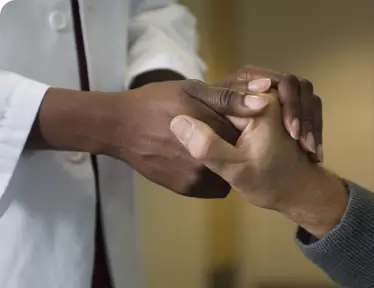



A lifesaving exchange

When Karen Patterson was diagnosed at age 28 with the initial stages of polycystic kidney disease, she was concerned but not surprised. Her father was suffering from life-threatening health issues caused by the genetic disorder, and she had a 50% chance of inheriting it.
Patterson learned everything she could about the condition. “Because I still had 80% kidney function, I knew I had time,” she says. “I had regular checkups and lived my life.”
The symptoms of polycystic kidney disease (PKD) appeared gradually and progressed over the decades, starting with elevated blood pressure. By age 35, fluid-filled cysts had developed on and inside her kidneys — a hallmark of the disease. By her 50s, the cysts grew larger and often ruptured, causing pain and dangerous infections that severely affected her quality of life.
“I was at Disneyland with my grandkids when I suddenly started to feel out of breath,” she says. “My ankles were swollen to the size of my knees. I had to be pushed in a wheelchair.”
Alarmed, she feared her kidneys might soon fail and she would need a transplant or dialysis. Her husband, Greg Patterson, a director of billing and planning for a medical equipment company, had vowed early in their relationship to donate his kidney to her. Then he learned he was not a blood or tissue match.
However, through the UCI Health Living Donor Program and the National Kidney Registry, Greg was able to donate one of his kidneys to a matching recipient with end-stage kidney disease. His donation enabled Karen to receive a healthy kidney from a matched donor in the Midwest whose wife needed a kidney.
Expanding living donor options
UCI Health and its Living Donor Program is one of only 11 National Kidney Registry member centers in California. In recent years, the registry has created many options for living donor matches through paired exchanges, vouchers and other programs.
When nephrologist Dr. Uttam G. Reddy first joined the UCI Health Kidney Transplant Program in 2015, the surgical team performed about 40 transplants a year. In 2025, the team performed 233 — a five-fold increase in the number of patients they were able to help. Reddy, medical director of the program, expects the number of kidney transplants will continue to rise. Unfortunately, about 2,000 people in Orange County alone need a transplant, and that number also is growing.
“If more people step forward to be living donors, we can save lives by closing the gap on how long patients have to wait to get a kidney transplant,” he says.
As Karen continued to monitor her worsening kidney function, she was dealt another blow. In 2019, at age 60, the retired medical assistant was diagnosed with breast cancer. She worried that cancer treatment might affect her ability to have a transplant in the future. The leader of her PKD support group at a Lake Forest church suggested she contact Reddy, who had spoken to their group previously.
“I wasn’t even his patient, and he spent 20 minutes helping me figure out how to get through this,” Karen recalls.
Reddy told her that if she had a lumpectomy, she would likely be put on medication that would make her ineligible for a kidney transplant. After consulting with her oncologist, she opted to have a double mastectomy and reconstructive surgery.
Through her support group, Karen learned about the national registry and also became Reddy’s patient. She also discovered that kidney disease patients didn’t have to wait until they were on dialysis to be eligible for a transplant — a common misconception. Instead, she could join the kidney registry database once her kidney function, known as the glomerular filtration rate, had dropped to 20%.
Fewer complications, better outcomes
“This option, called a preemptive transplant, is best,” says Reddy. “When the patient is not yet on dialysis, there are fewer complications and better outcomes.”
Greg had always accompanied Karen to her PKD support group meetings, conferences and doctor appointments. When he learned that he could still be a donor through the registry’s paired exchange program, he was all in.
“The first thing they do is weigh you to see if you’re a candidate,” he says. “I lost 60 pounds, and I’ve stayed there.”
Greg also underwent extensive medical tests to ensure he was healthy enough to donate. They revealed that he had an unusual kidney anatomy.
“Both his kidneys had three renal arteries instead of one, which is rare,” says UCI Health transplant surgeon Dr. Hirohito Ichii. “That increased the risk of complications.”
Greg underwent surgery to remove one of his healthy kidneys in October 2024. Although Ichii needed more time to complete the procedure because of the multiple arteries, it was a success. The healthy kidney was quickly flown to Northern California, where it was matched with a woman awaiting a deceased donor organ.
Greg bounced back quickly from the surgery. “Three or four days later, I felt pretty good. And after two or three weeks, I was back to where I was before.”
Rather than have her kidney transplant at the same time as Greg’s, Karen decided to wait until her husband was fully recovered and able to care for her after her surgery. She applied for a registry voucher, which she calls her “Willy Wonka golden ticket, good for one kidney.”
Six months later, in April 2025, when her kidney function had dropped to 17% and a matching donor was identified, she redeemed the voucher.
A surgical challenge
Ichii says Karen’s surgery also presented a unique problem. Typically, a patient’s failing kidneys are left in the body during transplantation. Because her kidneys were unusually large and cystic, the surgeon removed them to make room for her healthy donor kidney and decrease the risk of further infections.
“At one point in the hospital, I was hooked up to four poles with nine infusion bags hanging from them. It was all kind of a blur,” says Karen, who had a lengthy and more difficult recovery than Greg. “What I do remember is the kindness of everyone who cared for me. The whole UCI Health Kidney Transplant Program — all the nurses, doctors, the whole experience — couldn’t have been any better.”
After a six-month waiting period, organ donors and recipients are allowed to contact each other if both agree. Karen and her donor have established an email friendship. “He’s a lovely man, and his wife, who also got a donor kidney, is doing well,” she says.
Now 66, Karen is thriving with 98% kidney function. “People tell me that they’d never know I’d ever had anything wrong, that I look incredibly healthy,” she says.
Reddy says kidney transplantation is truly transformative. “You see people’s lives change overnight. As our program grows, one of our goals is to have a standalone clinic where pre- and post-transplant patients can come for all their transplant needs.”
A closer bond
Before her transplant, Karen and Greg often had to cancel travel plans due to her illness. “Greg was always good-natured about it and put my health and comfort first,” Karen says.
They now enjoy short day trips with their dachshund mix, Leo, and “crazy” Chihuahua, Zoey. A trip to Big Bear is also on their calendar.
“My recovery took about a year, and I’ll be on antirejection medicines for the rest of my life,” she says. “But I’m so active now and feeling much better.”
Today Karen volunteers with Local Love, a ministry at her church that distributes donations of food, new clothing and toys to local families in need. Greg is grateful to see her healthy and happy.
“Because donating an organ is a lifetime decision you make for the other person,” he says, “the surgeries have drawn us even closer.”
Learn more about the UCI Health Living Donor and Kidney Transplant programs.