



Pairing up to fight kidney failure
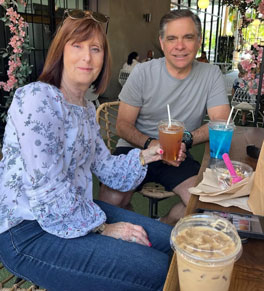
Karen Patterson knew for years that she might eventually need a kidney transplant.
When her father was in his 60s, his heart problems were traced to polycystic kidney disease, a mostly inherited condition that doesn’t skip generations. His physician recommended that she be tested. Patterson, then 28, was positive.
Polycystic kidney disease (PKD) affects about 500,000 people in the United States, according to the National Institutes of Health (NIH). It causes clusters of benign cysts to grow on the surface of the kidneys. In some cases, the organs become enlarged and begin to lose function. About half of people diagnosed with PKD will ultimately need a kidney transplant.
It was strong in her father’s blood line. “Everyone in my family died: my dad, my aunt,” Patterson recalls. “I decided to get myself educated on it.”
She joined support groups and read up. Patterson’s husband, Greg, pledged to donate his kidney when the time came. However, he was not a match. She’d have to find another way.
Paired exchange option
It was in a PKD support group where she first learned about paired kidney exchanges.
The idea is simple: a person donates a kidney to a stranger so their loved one can receive a kidney from another stranger, who is in turn donating for someone else. It would be how Patterson would receive a new kidney when the time came, and her husband would donate his for someone else in need.
By 2019, her kidney function had declined enough that she began preparing for a transplant.
A typical kidney is the size of an adult’s fist. “My kidneys were the size of bags of flour,” remembers Patterson, now 65. Standing 5 feet 2 inches tall, “I was so uncomfortable.”
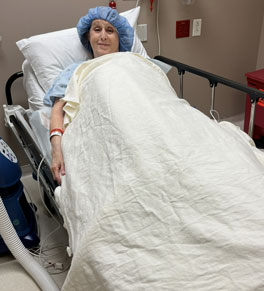
Patterson before her transplant.
A surprise cancer battle
During preparatory tests for the transplant, doctors discovered that she had breast cancer. It was an early-stage tumor, but it still complicated things. Patterson’s support group leader recommended that she reach out to nephrologist Dr. Uttam Reddy, medical director of the UCI Health Kidney Transplant Program. He returned her call one evening.
“I remember to this day, I was at a church service on Good Friday,” she recalls. “He talked to me on the phone for 20 minutes about how breast cancer treatment would affect my kidney transplant.”
She remains deeply grateful for and moved by Reddy’s call. “I wasn’t his patient, but he took the time to help me.”
Reddy explained that the breast cancer drug she would need to take for five to seven years after surgery to remove the tumor was incompatible with a kidney transplant. A double mastectomy was the only way to avoid the medication and move forward.
“Dr. Reddy was instrumental in helping me through that.”
In March 2019, her cancer was successfully treated at a hospital near her home in Rancho Santa Margarita, paving the way for her kidney transplant when the time came.
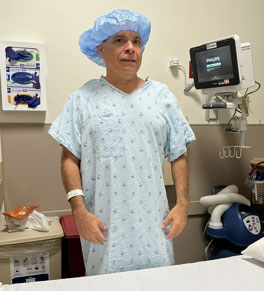
Greg Patterson before his kidney donation.
Getting a new kidney
Before her transplant, Patterson was active, volunteering at church, participating in food drives and hand-making cards. “I had to stop doing a lot of it because I just wanted to sleep.”
By 2024, when her kidney function had declined to 20%, she resumed testing for a transplant as part of a paired exchange.
Greg Patterson, who faithfully accompanied his wife to nearly every one of her support group meetings, donated his kidney in October 2024 and has fully recovered.
In April 2025, UCI Health transplant surgeon Dr. Hirohito Ichii removed both of Patterson’s enlarged kidneys and replaced them with a healthy donor organ through the paired-exchange program. The new kidney is a powerhouse, currently functioning at 90%.
“I feel good again,” she says, acknowledging that it takes about a year to fully recover and become used to the numerous medications that keep her — and her kidney — healthy.
Spreading the message
A year out from her transplant surgery, Patterson is feeling great and giving hope to others, letting them know about paired-exchange kidney donations whether she’s at church or in line at a coffee shop. That’s where she met a woman who'd been told she couldn’t donate to her aunt because they weren’t the same blood type.
“She’s now going through testing to donate to someone else,” Patterson says.
Even the people she talks to are sharing her message with others who want to donate a kidney but have been told they aren’t a match. Patterson wants everyone to know there is still a way they can help.
She also has connected with her donor, a man living in another state who was a blood and tissue-type match for her. In turn. the man’s wife received a healthy new kidney late last year. They chat regularly.
“When people tell me they can’t donate because they aren’t a match, I tell them, ‘You don’t have to be!’ It’s work, but you don’t have to be a match,” she says.
“More people need to know that.”
Learn more about becoming a living kidney donor.