




First-in-human study attacks pancreatic cancer with laser light
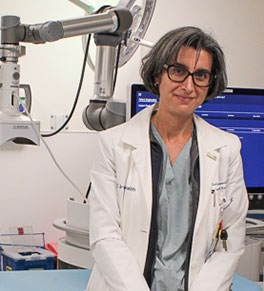
There are a many UCI Health studies underway to help get pancreatic cancer patients to surgery and ultimately cancer-free, says Dr. Nadine Abi-Jaoudeh, who leads a novel clinical trial for the disease. "We are advocating for better options and trying to get the word out to patients."
The UCI Health Chao Family Comprehensive Cancer Center is conducting a first-in-human, phase 1 clinical trial using laser light to target localized but inoperable pancreatic tumors.
Radiologist Dr. Nadine Abi-Jaoudeh, a nationally recognized expert in interventional approaches to treating cancers, leads the groundbreaking clinical trial, which uses the light-sensitive drug padeliporfin to destroy pancreatic tumors encasing major arteries in the abdomen. Once the vessels are clear of tumors, patients can undergo what can be a lifesaving surgery.
UCI Health is one of only two U.S. cancer centers testing the potential breakthrough treatment using vascular targeted photodynamic therapy (VTP), which was developed by the Israel-based biotechnology company, ImPact Biotech.
“First, we inject the patient with a light-sensitive drug,” Abi-Jaoudeh explains. “Then we insert a balloon into the tumor-encased blood vessel. Inside the balloon is a laser. When we turn it on, that activates the drug, killing the tumor surrounding the vessel.”
The VTP trial is one of many leading-edge clinical trials UCI Health offers for pancreatic cancer, including the breakthrough therapy daraxonrasib, a first-of-a-kind medication recently approved by the U.S. Food and Drug Administration (FDA). The daily pill works by blocking a protein mutation that spurs tumor growth.
Among deadliest cancers
Pancreatic cancer has one of the lowest survival rates of all cancers. One reason is that for the 50% of patients with localized cancer (meaning it hasn’t spread), two-thirds of them are not candidates for surgery. This is usually because their tumors wrap around major arteries that deliver blood to the abdomen, and surgery would risk damaging the vessels.
In preliminary results published in the Journal of Vascular and Interventional Radiology, Abi-Jaoudeh reported on three patients treated with the padeliporfin VTP therapy. Since then, another three patients have received the low-light therapy. Of the six total patients, four had the remaining tumor tissue surgically removed, and three of those patients had no evidence of cancer cells at the surgical margins.
“This is a significant finding because patients with localized cancers who cannot undergo surgery have similarly low survival rates as patients with metastasized pancreatic cancer,” says Abi-Jaoudeh, who is also a professor of radiology at the UC Irvine School of Medicine.
Destroying tumors from the inside out
VTP treatment is delivered in two increments of five minutes each after participants have been injected with the drug padeliporfin. Afterward, patients must spend three days in a dark room because exposure to light could cause damage to other areas, like the skin. That's why this therapy hasn't been used to treat larger areas.
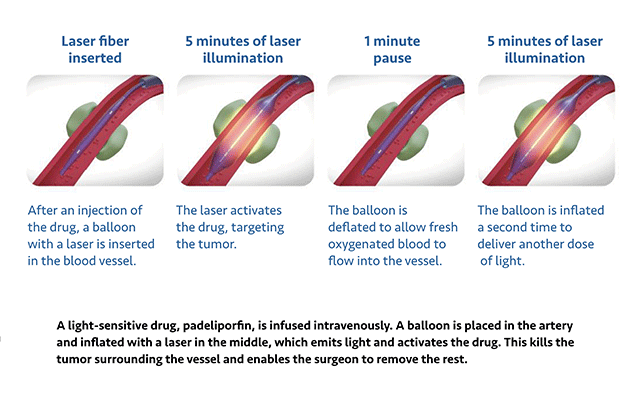
Illuminating padeliporfin causes a photochemical reaction within the blood vessel that breaks down the tumor vasculature and ultimately the tumor itself. Although tissue destruction begins immediately after treatment, the team waits two weeks before surgically removing the residual tumor tissue.
As part of the phase 1 trial, Abi-Jaoudeh is testing three incremental doses of laser illumination to determine the most effective one. If the results continue to show promise, she hopes to expand the study.
“If we’re able to confirm that this approach works, we hope to move to the next phases of the trial,” she says. “If approved for further testing by the FDA, phase 2 and phase 3 trials would test VTP therapy in significantly more patients.”
Offering patient better options
Abi-Jaoudeh was approached to lead the trial by ImPact Biotech researchers because of her expertise as well as that of the cancer center’s multidisciplinary pancreatic cancer team. She also is one of the few physicians to use minimally invasive, nonthermal tumor ablation techniques for other types of pancreatic tumors.
The cancer center’s pancreatic cancer specialists include her co-investigators: medical oncologist Dr. Jennifer B. Valerin and surgeons Dr. David K. Imagawa and Dr. Zeljka Jutric. The cancer center’s full range of medical and surgical expertise also enables more comprehensive management of trial participants.
“In communities that don’t have this level of expertise, once a patient is diagnosed with the inoperable kind of pancreatic cancer, physicians and patients reasonably tend to give up,” says Abi-Jaoudeh.
“But there are a lot of solutions being worked on, like this one, to get these patients to surgery and ultimately cancer-free. We are advocating for better options and trying to get the word out to patients."
Learn more about pancreatic cancer clinical trials at UCI Health