




UC Irvine receives its first ARPA-H award to advance lymphatic imaging, precision care
Up to $7.45 million will support development of noninvasive assessment technology
Orange, Calif. — UC Irvine has received its first award from the Advanced Research Projects Agency for Health, launching a major effort to improve how doctors detect and treat diseases of the lymphatic system.
The up-to-five-year, $7.45 million award supports a project called “Quantitative Assessment of Thoracic Duct Obstruction,” part of ARPA-H’s Lymphatic Imaging, Genomics and Phenotyping Technologies program, which seeks to better understand and diagnose lymphatic disease.
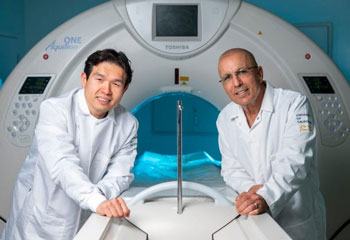
Led by Sabee Molloi, professor of radiological sciences, and co-investigator Cholsoon Jang, assistant professor of biological chemistry, the School of Medicine team is developing a safer, noninvasive way to assess lymphatic fluid flow, a process that has long been difficult to measure.
The researchers are working on an advanced imaging approach that uses CT scans to track lymphatic flow, paired with blood-based markers that offer additional clues about how the lymphatic system is functioning. Together, the tools could give physicians a clearer picture of problems that are often missed or diagnosed late.
“This award gives us the opportunity to assess the lymphatic system in ways that haven’t been possible before,” Molloi said. “Our goal is to make diagnosis more precise and treatment decisions more informed, without putting additional burden on patients.”
The project focuses on thoracic duct obstruction, a condition that can disrupt the body’s ability to move lymph fluid and is linked to serious health problems such as chronic abdominal pain, fluid buildup and nutritional deficiencies. Because symptoms can be vague and imaging options are limited, many patients go years without clear answers.
Currently in the early phase of the up-to-five-year endeavor, researchers are refining the imaging technology and testing it in preclinical models to ensure accuracy and reliability. Later phases will involve patient studies aimed at bringing the technology into clinical use.
“Our aim is to bridge the gap between innovation and patient care,” Jang said. “By combining imaging with biological signals from the blood, we hope to give clinicians more actionable information to guide treatment.”
If successful, the approach could help doctors choose the most appropriate protocol for each patient, whether that means monitoring symptoms, adjusting treatment plans or pursuing minimally invasive procedures, ultimately improving outcomes for people living with lymphatic disorders.
The ARPA-H LIGHT program is focused on advancing new technologies that shed light on the lymphatic system, which remains largely unexplored despite its importance to human health.
Originally published on UC Irvine News.
About UCI Health
UCI Health is one of California’s largest academic health systems and the clinical enterprise of the University of California, Irvine. Established on July 1, 1976, UCI Health has grown into a 1,513-bed health system that includes UCI Health — Orange, UCI Health — Irvine, its newest facility, UCI Health — Irvine Rehabilitation Hospital, four Community Network hospitals and a growing network of ambulatory care centers across Orange and Los Angeles counties. As Orange County’s only academic health system, UCI Health is home to the only National Cancer Institute-designated comprehensive cancer center based in the county, the region’s only American College of Surgeons-verified Level I adult and Level II pediatric trauma center, American College of Emergency Physicians Gold Level 1 Geriatric Emergency Department and a nationally recognized regional burn center verified by the American Burn Association. Powered by UC Irvine, UCI Health serves 5.6 million people across Orange County, western Riverside County and southeast Los Angeles County through excellence in patient care, research and medical education. Follow UCI Health on Facebook, Instagram, LinkedIn and X.