




Researchers seek to catch LATE dementia as early as possible
Form of memory loss affects up to 40% of older adults, says UCI Health neurologist
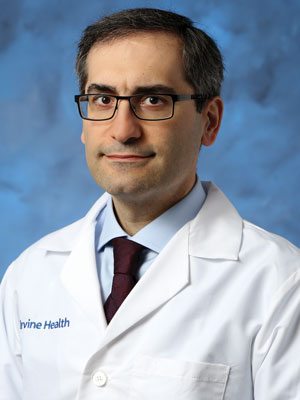
IN THE NEWS: Dr. S. Ahmad Sajjadi, a UCI Health neurologist who specializes in memory disorders, recently talked with Spectrum News In Focus about groundbreaking research related to a recently recognized form of dementia called limbic predominant age-related TDP-43 encephalopathy (LATE).
 LATE affects up to 40% of older adults. It causes memory loss and cognitive issues similar to Alzheimer’s disease, but it has a different underlying cause. On its own, LATE generally progresses more slowly.
“It is a common degenerative pathology that leads to memory problems, especially in people who are older than age 80.”
When LATE occurs with Alzheimer’s, the patient’s decline can be faster, so knowing when the dementia type is present is especially important.
The pervasiveness of LATE is why an $18 million grant from the National Institutes on Aging is funding a five-year study led by UC Irvine.
For more than 30 years, the UC Irvine Institute for Memory Impairments and Neurological Disorders (UCI MIND) has been at the forefront of Alzheimer’s and memory loss research. Sajjadi and his colleagues at the institute are studying LATE with two key goals: to diagnose it sooner and to discover treatments for it.
Sajjadi spoke about several actions to improve quality of life with LATE, including aerobic exercise to maintain blood circulation to the brain, a Mediterranean diet, and stimulation of the brain by being socially active and playing cognitively challenging games.
“These are all things that can save the brain and make the participants and patients have a meaningful life for years ahead of them.”
Sajjadi is the recipient of multiple National Institutes of Health grants and also the inaugural UCI MIND Joan and Don Beall Scholar Award. He is a professor of neurology and pathology at the UC Irvine School of Medicine. A clinician scientist who studies neurodegenerative pathologies across the aging spectrum, Sajjadi's research focus includes Alzheimer's disease, primary progressive aphasia, frontotemporal dementia and dementia in the oldest adults.
For more information on the research into LATE, visit late.mind.uci.edu.
To make an appointment with the UCI Health Memory Disorders Program, call 714-456-7720.
About UCI Health
UCI Health is one of California’s largest academic health systems and the clinical enterprise of the University of California, Irvine. Established on July 1, 1976, UCI Health has grown into a 1,513-bed health system that includes UCI Health — Orange, UCI Health — Irvine, its newest facility, UCI Health — Irvine Rehabilitation Hospital, four Community Network hospitals and a growing network of ambulatory care centers across Orange and Los Angeles counties. As Orange County’s only academic health system, UCI Health is home to the only National Cancer Institute-designated comprehensive cancer center based in the county, the region’s only American College of Surgeons-verified Level I adult and Level II pediatric trauma center, American College of Emergency Physicians Gold Level 1 Geriatric Emergency Department and a nationally recognized regional burn center verified by the American Burn Association. Powered by UC Irvine, UCI Health serves 5.6 million people across Orange County, western Riverside County and southeast Los Angeles County through excellence in patient care, research and medical education. Follow UCI Health on Facebook, Instagram, LinkedIn and X.