




Gastric cancer survivor credits novel clinical trial therapy
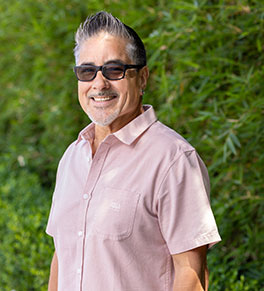
In the fall of 2023, Mauricio Alvarez was given no more than a year to live after being diagnosed with advanced stomach cancer.
Two years later, he has beaten the odds thanks to a unique clinical trial developed by UCI Health gastric cancer specialists. Today, the 61-year-old mechanical engineer has no sign of the deadly disease.
Alvarez has a very good chance of extended, progression-free survival, says surgical oncologist Dr. Maheswari Senthil, a national expert in advanced abdominal cancers and director of the peritoneal malignancy program at the UCI Health Chao Family Comprehensive Cancer Center.
She led the clinical trial with medical oncologist Dr. Farshid Dayyani, director of the cancer center's Stern Center for Clinical Trials and Research.
"I wouldn't be here if it wasn't for Dr. Senthil and Dr. Dayyani," says the father of seven and grandfather of 10. “I want the world to know how great these doctors are. They are always looking to innovate, to find treatments that can help others."
Improving survival
Senthil and Dayyani launched the clinical trial called STOPGAP in 2021 to find a better treatment for patients like Alvarez with stage IV gastric cancer, which disproportionately affects Latinos and younger adults.
It has a survival rate of six to 12 months even with the best systemic chemotherapy regimen available. Those poor results reflect the inability of the intravenous treatment (IV) to penetrate the abdomen's peritoneal lining.
The goal, Dayyani says, was to offer patients “a more aggressive treatment option that targets cancer cells where they reside.”
STOPGAP's multipronged approach combines systemic therapy with three months of chemotherapy delivered directly into the abdominal cavity through a peritoneal port. Next, Senthil performs surgery to remove all visible tumors and bathes the area with a heated chemotherapy solution to kill any lingering microscopic cancer cells.
Armed with seed money from the UC Irvine Anti-Cancer Challenge, a cycling rally founded in 2017 to raise funds for innovative, homegrown cancer research, Senthil and Dayyani won approval to test their concept in the early phase clinical trial at the cancer center in Orange.
Since 2021, more than 35 patients have participated in the STOPGAP trial, with promising results to be presented to the scientific community in January at a national conference on gastrointestinal cancers.
National impact
The trial’s success has paved the way for STOPGAP II, a randomized, multi-arm national phase 2/3 clinical trial now open to patients at UCI Health as well as dozens of leading U.S. cancer centers.
Senthil is the national principal investigator of the current trial, which is supported by the National Cancer Institute and the Eastern Cooperative Oncology Group.
Learn more about the STOPGAP II clinical trial ›
Participants in one arm of this trial will receive standard-of-care IV chemotherapy; the other will receive the STOPGAP I protocol of IV chemotherapy and direct intraperitoneal chemotherapy. After chemotherapy, eligible patients in both groups can undergo cytoreduction surgery.
“The current standard of care for advanced gastric cancer is mainly palliative,” says Senthil, a professor and John Wayne Cancer Foundation endowed chair in Surgery at the UC Irvine School of Medicine. "We believe this approach will give these patients much better outcomes and longevity.”
Poor prognosis
Alvarez, whose chronic digestive problems were thought to be caused by ulcers, was hospitalized near his Riverside home on Oct. 31, 2023, unable to eat and with rectal bleeding. A few weeks later, after multiple tests and a biopsy, he was diagnosed with a stage IV gastric cancer.
The doctor said he could offer little in the way of effective treatment, but he told Alvarez that Senthil, a former colleague now at UCI Health, might be able to help.
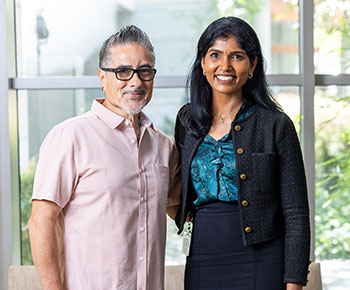
Once a burly 218 pounds, Alvarez weighed about 128 pounds when he first met with the UCI Health cancer specialists in early December 2023.
“Dr. Dayyani walked in and he just lit up the room right out of the gate,” recalls Alvarez. “He said, ‘I’ve read your file and this is a type of condition I’ve dealt with. There is a clinical trial and there are so many things that we can do for you.’ Oh my god, I love that guy!.”
Senthil was equally reassuring throughout his treatment, even when telling him that scans showed his tumor, about the size of a softball, was wrapped around the main arteries to his liver, making chemotherapy difficult.
“She was just so positive and encouraging.”
Alvarez started the regimens of chemotherapy in January 2024. By July, Senthil removed the visible tumors and applied the heated intraperitoneal chemotherapy bath.
Building strength, loving life
Two years after his original diagnosis, Alvarez is working, exercising regularly and getting monthly immunotherapy infusions to help his body combat any recurrence.
He has regained much of his strength and his weight is up to 185 pounds. “My forearms are coming back,” he says with evident pride. “When I see Dr. Senthil now, she tells me ‘You’re doing great.’
He is also treasuring the time he has been given with his wife, Arlene, his adult children and their kids.
“I’m so fortunate, so blessed," he says. "I have faith in my doctors. They are doing everything they can to save me. I never doubted it. Never.”
Learn more about UCI Health clinical trials ›
To learn more about the UCI Health Chao Family Comprehensive Cancer Center or to make an appointment, please call 714-456-8000.