




Colonoscopies: more comfortable than ever
Few procedures are as efficient or as good at preventing cancer as the mighty colonoscopy.
“Colonoscopies not only detect cancer, they also prevent it when any precancerous polyps are found and immediately removed,” says Dr. William E. Karnes, a gastroenterologist with the UCI Health Digestive Health Institute.
But they aren't exactly fun, he concedes.
“Neither you nor I would fuss with colonoscopies if they weren’t so good at preventing cancer,” Karnes says.
However, the procedure has vastly improved over the years. Nimble new tools, updated practices for increased patient comfort, faster recovery time and improved polyp detection all make for a better experience.
“The colonoscopy of today is light years better than your grandparents' or even your parents' experience,” Karnes says.
Here are several reasons why.
Ditching the air
The air typically used to inflate the colon for examination leads to uncomfortable bloating and gas later. Karnes uses water and carbon dioxide (CO2) instead.
“This method is also a lot more comfortable for patients,” he says. “Carbon dioxide is rapidly absorbed and released by the lungs, which eliminates bloating after the procedure.”
It also helps the gastroenterologist spot flat polyps, which float in water, making them easier to see and remove.
Better scopes
Modern scopes are also more flexible and easier to maneuver within the colon, making the experience more comfortable for the patient, Karnes says.
Their higher image resolution also makes it possible to find very small polyps.
Some newer scopes even have flexible finger-like appendages that turn the folds of tissue in the colon wall so that the doctor doesn’t have to.
“That’s better for examining every fraction of an inch."
Optional sedation
Sedation has typically been needed for a patient undergoing a colonoscopy. That means they wake up groggy after the procedure, Karnes says, adding, “They need someone to drive them home and basically the rest of the day is lost.”
Now that colonoscopies have gotten more comfortable, a patient may not need sedation if they don’t want it.
Often, any discomfort people feel has more to do with anxiety than actual pain, says Karnes, who lets his patients choose whether to opt for sedation.
"Some may only need an anti-anxiety medication, while others will want to be completely sedated."
A better prep
Preparing the colon for examination is famously the most dreaded part of the colonoscopy process.
“The laxative liquids used to clean out the colon can taste awful,” acknowledges Karnes. “On top of that, the day-long, clear-liquid fast leaves people hungry.”
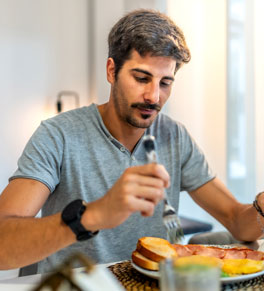
Research led by UCI Health gastroenterologist Dr. Jason Samarasena shows that people can eat low-residue foods on the day before their procedure and have a successful colonoscopy. These foods include eggs, bacon, white bread and pasta with butter, which don’t leave any fiber deposits for the colon to eliminate.
The 2021 study published in the Digestive Disease and Sciences journal showed that the low-residue prep actually left the colon cleaner than a complete fast.
It is possible to mix certain over-the-counter laxative powders with soda, sports drinks and flavored waters to make the preparation taste more like your favorite beverages. But Karnes says it important to stick with clear or yellow fluids.
Regardless, patients should always follow their physician’s prep instructions. Karnes wishes more patients understood the importance of a good prep.
“I can use the latest techniques and the greatest care in finding problem polyps, but it’s even more important for you to do a good prep," he says. "It really takes the two of us to prevent colon cancer.”