




Colon cancer survivor raises awareness
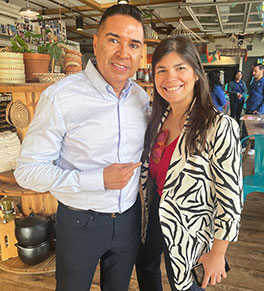
Sick with the flu, Jorge Sotelo went to see his primary care doctor in the fall of 2024. That visit would lead to a colon cancer diagnosis, surgery and a new mission to raise awareness about the disease within the Spanish-speaking community.
Although the Riverside resident had no symptoms of colon cancer at the time, he asked if he could get another colonoscopy. His primary care doctor reminded him that he’d had one three years earlier and wasn’t due for another two years.
“I felt pushed to ask again, telling him that they had found and removed polyps during my first one,” Sotelo explains. The doctor agreed to schedule it.
That colonoscopy revealed a large two-inch tumor in his colon.
“I don’t know where I’d be today, if I had waited another two years,” says Sotelo, now 59.
After the diagnosis, he was referred to Dr. Valery Vilchez Parra, who specializes in minimally invasive and robot-assisted surgery for colon and rectal cancers at the UCI Health Chao Digestive Health Institute.
Early detection makes the difference
Colorectal cancer is the second-leading cause of U.S. cancer deaths, but it is also among the most preventable — and treatable — when caught early.
“Jorge’s tumor was diagnosed as stage II, T3 colon cancer, which means it had grown through the outer colon wall but had not spread to the lymph nodes or distant organs,” says Vilchez Parra.
"Thankfully, his cancer was in an early stage and he did not have any high-risk factors that required systemic therapies to avoid recurrence.”
She removed Sotelo’s tumor and a portion of his colon where it had lodged on Oct. 23, 2024. After three days in the hospital, he went home to recuperate.
Savoring his blessings
 “I took three months off of work,” says Sotelo, executive pastry chef at Disney’s Grand Californian Hotel & Spa in Anaheim.
He is the mastermind behind many fantastical creations that delight hotel patrons, including this Peach and Honey Semifreddo, a nod to Winnie the Pooh lovers everywhere.
The father of three welcomed his time at home with Lupita, his wife of 30 years.
“It was a wake-up call for me,” he says. “I’d never had the time to stop and really notice the blessings — to be able to walk around, to have a roof over my head and a bed — to really value that we are alive, that we have a family.”
But when the time came, Sotelo happily returned to his hotel family. “For me, going to work is like therapy. I can create and bring joy to others.”
Preventing recurrence
Now a year and half after surgery, Sotelo remains cancer-free and in good health while still under the watchful eye of his UCI Health doctors.
“Jorge continues to be under surveillance with us,” says Vilchez Parra. “That means he needs to get bloodwork done every two months and a colonoscopy every year to check for polyps or other changes to his colon.”
In fact, during his colonoscopy in November 2025, four polyps were removed. “That’s how you beat this disease — by catching things early before they turn cancerous,” he says.
Sotelo is grateful for the personalized treatment he received at the Chao Digestive Health Institute. “I want to really thank Dr. Vilchez and her team for their exceptional care. Even now, I can text them and I will get an answer right away. It’s comforting.”
This patient-focused, multidisciplinary care is a hallmark of the institute, Vilchez Parra says. “We maintain the highest standards of quality and our patients also have access to the latest clinical trials in colon and rectal cancer therapy.”
Raising awareness
Recent data show that much of the rise in colorectal cancers, especially among adults under age 50, is growing faster among Latinos, who are fare less likely to get screened for the disease.
Together, patient and surgeon have dedicated themselves to educating the region's Spanish-speaking communities about colon and rectal cancer, the symptoms and the importance of regular exams beginning at age 45.
“When I was first diagnosed, I shared that with my brothers, my friends at church, my colleagues at Disney, and they went to get their colonoscopies right away,” Sotelo says.
He and Vilchez Parra have even spoken about the need on the popular bilingual, bicultural “Shoboy Show,” a radio program created and hosted by his brother Edgar Sotelo.
He has also shared his experience with another brother, Eddie “Piolín,” Sotelo, on “El Show De Piolín,” a radio program syndicated across 60 U.S. Spanish-language radio markets.
Voice for the underserved
“Being a voice for an underserved Spanish-speaking population is so important,” Vilchez Parra says. “I think there is a bit more fragmentation of care and more difficulties even understanding the disease process when you speak a different language.”
Sotelo, his family and their larger community of friends "are perfect examples of what you can do,” she adds.
“You can use your voice and your experience to actually help others navigate through not only the journey of cancer but possibly preventing that journey altogether through education and early screening.”
Helping others survive this most preventable of cancers is what drives her each day.
"People like Jorge are why I became a physician, why I became a surgeon and why I decided to do colorectal surgery. It’s the beauty of being able to walk the journey with someone and help change their life for the better.”
Related stories
Explore further
Browse more blog posts by topic.