




Leading a medical training initiative in Tanzania
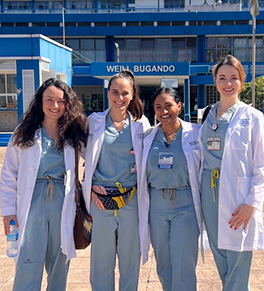
UCI Health gynecologist Dr. Anjali Y. Hari has always had an interest in global health. But as an undergraduate student working with malnourished children at a clinic in Guatemala about 15 years ago, she had an epiphany — that donations alone don’t offer long-term, sustainable solutions.
“Global health should be about teaching and education and capacity building, not just donating supplies or money,” says Hari, who specializes in gynecologic cancers. When she saw an opportunity in 2013 to teach an ultrasound course in Tanzania during her first year of medical school at UC Irvine, she immediately applied.
“I fell in love with the work,” says Hari, who has returned almost every year since. “Each visit, we would build upon what we did the year before.”
Now, as an assistant professor of obstetrics and gynecology in the UC Irvine School of Medicine, Hari continues building relationships in Tanzania, partnering with local teams in Mwanza and with the Bugando Medical Center.
She and her UCI Health colleagues regularly collaborate with physicians in Tanzania’s second largest city on training, research and surgical care.
Building a global collaboration
“My efforts have focused on building sustainable, bidirectional training and research infrastructure,” she says. “What started as a training program for mid-level providers to screen for and treat cervical cancer has grown into a global collaboration that includes joint research projects, a graduate medical education rotation and building cancer center capacity together.”
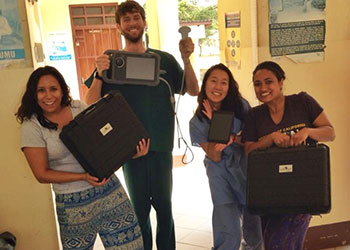
It all started in 2013, when Hari, alongside a small group of trainees, helped develop and teach an anatomy curriculum using ultrasound, which addressed the lack of access to traditional anatomy labs for these mid-level providers. In 2014, she returned with about 10 UC Irvine medical students to teach an advanced ultrasound-based pathology course and conduct early research on malaria and schistosomiasis.
From 2015 to 2019, Hari’s annual visits expanded to include cervical cancer prevention. In partnership with an organization called CureCervicalCancer, she helped implement high-volume screen-and-treat campaigns, training healthcare providers in visual inspection with acetic acid (VIA) and supporting same-day treatment with donated cryotherapy equipment. That led to research examining VIA screening differences across rural and urban settings.
In 2020, during the COVID-19 pandemic, Hari transitioned to long-distance training, developing a virtual ultrasound curriculum for the emergency department at Bugando Medical Center. In 2021, her work shifted to systems-level interventions in cervical cancer care and research focused on patient navigation to reduce barriers to chemoradiation.
In 2024, Hari received pilot funding from the Department of Population Sciences in the Program of Public Health at UC Irvine to teach a global class on grant writing and research ethics — the first of its kind at the university. This was in collaboration with Heike Thiel de Bocanegra, PhD, vice chair of OB/GYN research at UC Irvine, and Humphrey Mazigo, chair of public health at the Catholic University of Health and Allied Sciences/Bugando.
“We also host a monthly joint lecture series connecting faculty and trainees across institutions,” says Hari. “These efforts are supported by ongoing research collaborations in infectious disease and cervical cancer, as well as emerging philanthropic initiatives to expand faculty exchange, training and research capacity.”
Training a new generation of physicians
In 2025, Hari launched a graduate medical education (GME) elective for UC Irvine OB/GYN residents and fellows at Bugando Medical Center. Trainees obtain a Tanzanian medical license to participate in surgical care at the 1,000-bed hospital, working alongside Bugando gynecological oncologists Edgard Ndaboine, MD, and Amina Yussuph, MD.
They also engaged in collaborative research on cervical cancer and infectious disease. To date, they have completed three elective rotations, the most recent in February 2026.
“It’s a great educational opportunity for our trainees to learn, because they see a lot of pathology that is very different from what we see in terms of cervical cancer and maternal hemorrhage in the U.S.,” says Hari. “They also gain a new perspective by seeing how our specialty is practiced in a limited-resource setting.”
“I was able to work with Dr. Ndaboine and learn his techniques for lymph node dissection and how he performs radical hysterectomy,” says Jennifer Draganchuk, MD, who spent two years on a gynecological team in Malawi before becoming an OB/GYN fellow at UC Irvine in 2025.
She accompanied Hari to Tanzania in February, along with OB/GYN colleagues Thiel de Bocanegra and resident Courtney Fant, MD, as well as UCI Health radiation oncologist Dr. Priya Mitra, who also serves as an assistant professor of radiation oncology at UC Irvine.
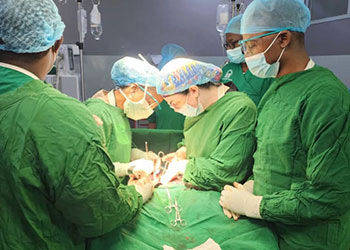
“I was able to work with the Bugando residents and show them techniques I have picked up throughout my training, both in the U.S. and from my mentors in Malawi,” says Draganchuk, who stressed the “kindness, talent and pure excellence” of everyone she worked with at Bugando.
The next GME rotation will take place this May, with OB/GYN fellow Lila Marshall and residents Kate Correy-Saveda and Eliana Garcia.
The collaboration goes both ways.
“Dr. Ndaboine visited Irvine in 2025 to complete an observership with me thanks to funding from the UC Irvine Department of Obstetrics and Gynecology,” says Hari. “He got to visit our operating rooms and participate in an ovarian cancer debulking course as part of our partnership.”
Creating a gynecologic oncology fellowship program
Hari is also developing a gynecologic oncology fellowship program in Tanzania, working with the International Gynecologic Cancer Society.
“Tanzania currently doesn’t have any GYN/ONC fellowships, so everyone has to leave the country to get trained,” says Hari. “Dr. Ndaboine went to India and Dr. Chibwe went to Uganda, so we’re hoping to establish the first fellowship site in Tanzania.”
They also hope to create a radiation oncology GME program, which is why Mitra joined the team in February to conduct a needs assessment.
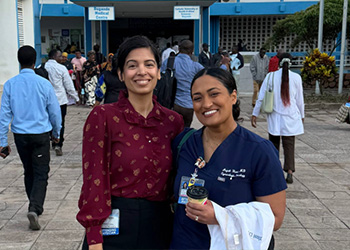
“I’m excited for them to take the next step. My hope is that we can do in Tanzania what we did in Ethiopia.”
Hari has seen the work continue every year for over a decade, with more collaborators stepping in to help expand this global health program.
“There is mutual respect and learning, and we’re trying to build capacity,” she says. “This has been a big passion project since I was in medical school. Now to be faculty here and still building the program is, honestly, incredible.”
Recent cuts to USAID make support for this work needed more than ever. Help fund this global health collaboration by making a donation today to the Department of Obstetrics & Gynecology as part of UC Irvine’s 2026 Giving Day campaign.