




Protecting your lungs during wildfires
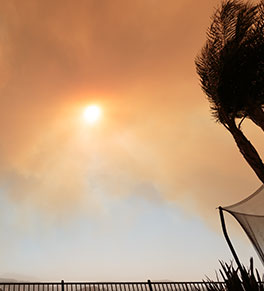
In California, wildfires can ignite year-round, with peak activity from late spring through fall.
As fires raged and spread across Southern California in mid-May, the resulting smoke and ash caused air quality to plummet to dangerous levels in areas surrounding them.
“People with underlying lung diseases — like asthma or chronic obstructive pulmonary disease, vascular disease or diabetes — should stay indoors in order to minimize exposure,” says UCI Health pulmonologist Dr. Richard A. Lee.
“Adults 65 and older, children and pregnant women are especially susceptible. Older adults and those with preexisting heart or lung conditions have less reserve to handle the added stress and immunocompromised individuals are at higher risk of infection.”
Children breathe more air per pound of body weight and their lungs are still developing, adds Lee, who directs the intensive care unit at UCI Health — Irvine.
Smoke can spread the danger
Apart from the damage wildfires can cause to life and property, their fumes contain vapors, gases and tiny airborne particles that travel huge distances, potentially affecting communities hundreds of miles away.
The particles generated by the burning of biomass materials from trees and shrubs contain metals (some toxic) and organic materials — many of which are irritating to the respiratory tract.
“Wildfire smoke contains fine particulate matter known as PM2.5 — particles 2.5 micrometers or smaller that are small enough to bypass the body’s natural filters in the nose and airways and lodge deep in the lungs,” Lee says. “There they can also enter the bloodstream and affect the heart.
“Wildfire smoke also contains polycyclic aromatic hydrocarbons, or PAHs, which form from incomplete combustion and are known carcinogens.”
Wildfire smoke also differs from everyday city air pollution. Lee says the particles are smaller, more chemically reactive and enriched with reactive organic compounds that can become more toxic as the smoke drifts and ages. Even short exposures to wildfire smoke can trigger significant respiratory and cardiovascular effects than similar levels of urban smog.
Monitor your breathing
Lee advises people to pay attention to their breathing.
“Watch out for symptoms such as wheezing, shortness of breath, difficulty taking a full breath, chest tightness or pressure, irregular or pounding heartbeat, lightheadedness and dizziness,” Lee says.
“If your symptoms are not relieved by the usual medicines, contact your physician immediately. Severe shortness of breath or wheezing, inability to speak in full sentences, chest pain or confusion are red flags. If you are experiencing respiratory distress, go to the nearest emergency room for evaluation or call 911.”
Safety tips
If you smell smoke or see ash from a wildfire, the South Coast Air Quality Management District recommends the following safety measures to limit your exposure:
- Avoid vigorous physical activity outdoors.
- Remain inside with windows and doors closed or seek alternate shelter.
- Seal visible gaps around windows and doors with weatherstripping or tape to further reduce indoor exposure.
- Run an air conditioner if you have one and set it to recirculate the indoor air to prevent drawing smoke inside. Make sure it has a clean filter, preferably a high-efficiency (HEPA) filter that offers the best protection against fine particles.
- Create a clean air space in your home by using a portable air cleaner in addition to, or instead of, the air conditioner.
- Avoid using a whole-house fan or a swamp cooler that draws air into your home.
- Avoid using indoor or outdoor wood-burning appliances, including fireplaces.
- Avoid burning candles or incense.
- If you must drive during smoky air conditions, close windows and vents and run the vehicle’s air conditioner in recirculate mode.
Lee also recommends monitoring the local air quality index (AQI) to know when it’s safe to be outside. An AQI above 100 is considered unhealthy for sensitive groups and readings above 200 warrant strong protective measures and avoidance of outdoor activity for everyone.
Because AQI values are typically reported as hourly or daily averages, which can smooth out short-term spikes in smoke, it’s wise to also pay attention to how you feel and to step inside if symptoms develop, Lee notes. In addition, hyperlocal air-quality sensor networks such as PurpleAir offer a more neighborhood-level picture of PM2.5 levels.
For more information on wildfire resources and to get air quality alerts, please visit SCAQMD.
Outdoor protection
If you can’t avoid going outdoors, Lee suggests wearing protective gear.
Paper and cloth masks don't provide adequate protection from smoke, according to the U.S. Environmental Protection Agency (EPA). Dust masks made of paper can block large particles such as sawdust, but they do not protect your lungs from small particles or gases found in wildfire smoke.
“If you do have to go outside, wearing a mask that protects you against the fine particulate matter, an N95 mask or greater is recommended,” he says.
Learn more about using respirators and getting a proper fit.
After a wildfire
To safely clean up ash once the wildfire has ended, the California Department of Public Health recommends the following:
- Wearing a close-fitting respirator that is rated N-95 or P-100 to prevent ash from being inhaled. Bandanas, surgical or cloth masks do not effectively block fine particles.
- Wearing protective gloves, long-sleeved shirts, long pants, socks and shoes to avoid skin contact with ash.
- Avoiding use of a leaf blower, which spreads the ash and blows it back into the air.
- Avoiding or household vacuum cleaners unless they have HEPA filters to prevent particles from blowing into the air where they may be inhaled.
- Removing shoes before entering your home or using a sticky mat in entryways and doors to capture dust and ash from your shoes. Sticky mats are sold at hardware stores.
- Gently sweeping indoor and outdoor hard surfaces, followed by wet mopping. Use a damp cloth on surfaces that have a light coating of ash dust.
- Washing any ash on your skin as soon as possible.
- Restricting children or pets from playing in ashy areas and washing off toys before use.
“The single most effective thing you can do during wildfire season is to take smoke seriously before you feel sick,” Lee says.
“Keep tabs on the air quality, gather your medications and N95 masks before a fire breaks out, and don’t wait for severe symptoms to get help. A little preparation now can prevent a trip to the emergency room later.”