




Moles & melanoma: Everything you need to know
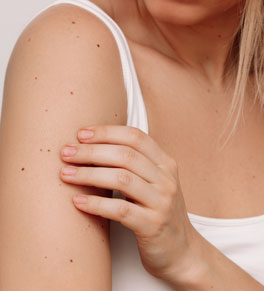
Nearly every adult has a few moles. Fair-skinned people may have as many as 40 on their bodies. Most of them are nothing to worry about.
“Yes, a common mole can turn into melanoma, but that’s very rare,” says Dr. Maki Yamamoto, a surgical oncologist with the Melanoma Center at UCI Health Chao Family Comprehensive Cancer Center.
Common, noncancerous moles can be pink, tan or brown spots, aggregations of pigmented cells that are either round or oval in shape and have a smooth surface. But it’s important to keep an eye out for atypical moles that may put you at higher risk for melanoma, she says.
Skin cancers are by far the most common U.S. cancer. It will affect one in five people in their lifetimes. It is even more prevalent in sunny Southern California. The three most common types are basal cell carcinoma, squamous cell carcinoma and melanoma.
Melanoma accounts for only 1% of all skin cancers. But it is the deadliest, claiming an estimated 8,500 lives each year, because it is grows rapidly and has a higher propensity to spread to lymph nodes or other organs than basal and squamous cell carcinomas. When detected and treated early, the five-year survival rate is 99%, according to the American Cancer Society.
Yamamoto, an associate professor at the UC Irvine School of Medicine Department of Surgery, shares what everyone needs to know about moles and melanoma.
Recognizing atypical moles
Atypical moles are often larger than the head of a pencil eraser and oddly shaped. They may also be more than one color.
“Sometimes it can be difficult to tell the difference between a benign atypical mole and a melanoma,” Yamamoto says.
She suggests looking for what’s called the ABCDEs:
- Asymmetry: The shape of one half does not match the other half.
- Border that is irregular: The edges are often ragged, notched or blurred in outline. The pigment may spread into the surrounding skin.
- Color that is uneven: Shades of black, brown and tan may be present. Areas of white, gray, red, pink or blue may also be seen.
- Diameter: There is a change in size, usually an increase. The larger the mole, the greater the chance of malignancy.
- Evolving: The mole has changed over the past few weeks or months.
An atypical mole that bleeds easily or is itching, painful, swelling, crusting or oozing should be checked right away by a dermatologist or physician experienced with skin disorders.
Any concerning moles that fit the ABCDE criteria should be removed, Yamamoto says.
Finding melanoma
Melanoma can be found anywhere on the body, from the top of the head to the bottom of the feet. In fact, only 20% to 30% of melanomas are found in existing moles.
“As we get older, they have a propensity to be on sun-exposed areas such as the head, neck and trunk,” Yamamoto says.
“Check your skin and existing moles often, following the ABCDEs. And see a doctor if you are concerned.”
Melanoma diagnosis and treatment
Sometimes melanoma can be detected just by looking at the skin, Yamamoto says.
“But the only way to accurately diagnose it is with a biopsy.”
If a suspicious mole is confirmed to be melanoma and it’s early-stage, surgery is the usual treatment.
Immunotherapy is the treatment for late-stage melanoma that has spread to other parts of the body, she says.
Staying safe from the sun
The best way to prevent melanoma and other skin cancers is to protect yourself from the sun and its ultraviolet rays year-round, in all types of weather.
Yamamoto’s skin cancer protection recommendations are:
- Use sunscreen with a sun protection factor (SPF) of at least 30.
- When you are outdoors, reapply sunblock every two hours.
- If you are engaged in outdoor water sports, reapply sunblock every time you come out of the water.
- Wear hats that shield your face and scalp.
- Cover your arms and legs with long sleeves and long pants.
- Avoid tanning beds, which are associated with an increased risk for melanoma and other skin cancers.
“Melanoma is highly treatable if caught in its earliest stages,” Yamamoto says. “But the best medicine is prevention.”