




One neurosurgeon's quest for a better tool
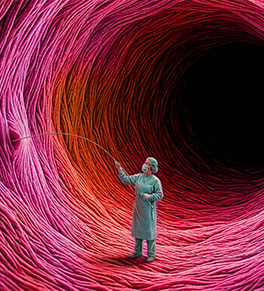
As a UCI Health neurointerventional surgeon, Dr. Ichiro Yuki spends his days navigating some of the body’s narrowest and most fragile passageways. Through tiny catheters threaded into blood vessels, he treats aneurysms, strokes, vascular malformations and other potentially devastating conditions deep inside the brain.
What still surprises many people, including Yuki himself, are the tools some of those procedures routinely rely on. One of the standard liquids physicians inject into blood vessels to block blood flow to aneurysms and other conditions, is essentially a medical version of super glue. Another commonly used embolic material depends on a powerful organic solvent that Yuki compares to nail polish remover.
“You probably don’t believe it,” the neurosurgeon says with a laugh. “But this is the most commonly used material for this purpose on the market right now.”
Some of the polymers tended to stick to catheters. Others were difficult to control or harsh on delicate vessels. Neurosurgeons often had to work carefully to avoid trapping a catheter inside the brain.
“No one believes that we are using ideal materials,” Yuki says. “We just got used to them.”
Serious consequences
The consequences of adapting to those limitations have at times been severe. U.S. Food and Drug Administration (FDA) reports describe more than 50 cases in which catheters became trapped during brain procedures using one common embolic material. Multiple deaths were linked to the complications. Other materials can damage blood vessels or lose effectiveness over time, allowing blocked vessels to reopen.
Instead of accepting “good enough,” Yuki decided early in his medical career to try building something better.
What has emerged from that decision is the Aqua Embolic System, or AES, a hydrogel material intended to move through tiny blood vessels without sticking to the catheter delivering it. AES is also designed to remain visible under X-ray imaging as it moves through tiny blood vessels, allowing physicians to track the material more precisely during procedures.
Solving the material problem was only the beginning, however. To move the technology beyond the lab, Yuki had to learn an entirely different discipline involving patents, funding, navigating the FDA regulatory process and creating an enterprise to produce and test the material. At UC Irvine, Beall Applied Innovation became his entry point into that world and the formation of a startup venture, AquaTex Medical.
Encountering the material challenge
After completing neurosurgical training in Japan, Yuki arrived at UCLA in 2002 to learn emerging catheter‑based neurointerventional techniques to treat brain aneurysms from inside the blood vessels, rather than through open skull surgery. The minimally invasive techniques were transformative, and Yuki wanted to be at the forefront of that transformation. It was there he encountered the material problem.
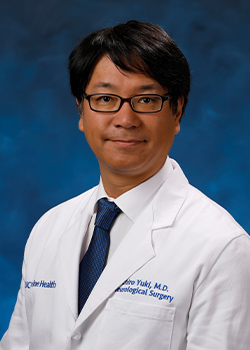
He spent eight years at UCLA refining both his clinical and research skills before returning to Japan, where he continued treating patients as well as researching catheter-based devices and better embolic materials at Jikei University School of Medicine in Tokyo. Eventually, he returned to the United States and is now part of UCI Health Neurosurgery Services and a clinical professor in UC Irvine School of Medicine’s Department of Neurological Surgery.
He was drawn to UC Irvine in large part by the flexibility to pursue both clinical practice and research. At UC Irvine, he was able to split his time evenly between treating patients and developing new technologies.
Another reason was the opportunity for innovation. Yuki had already experienced how difficult commercialization could be in Japan. When he first approached an intellectual property office there about one of his ideas years ago, he was told there was no one available, that he would have to navigate the process himself. UC Irvine offered a dramatically different experience.
“I was introduced to the senior intellectual property officers immediately,” he says. “They guided me through everything.”
That guidance included programs such as the Proof of Product (PoP) grant program, I-Corps, a National Science Foundation-funded program that helps researchers conduct customer discovery and Wayfinder, a startup support program that has since been replaced by customized venture support through UC Irvine Beall Applied Innovation. Beall staff also helped connect Yuki with federal funding opportunities, including National Institutes of Health (NIH) Small Business Technology Transfer (STTR) grants.
“They know how to support new technologies and help them grow,” Yuki says of the UC Irvine ecosystem. “I feel so lucky that I was able to come back and join the team here.”
Solving the problem
When Yuki began the search for a better embolic options for delicate brain procedures in Japan, he turned to Dr. Kousaku Ohkawa, a well-known polymer scientist. For nearly a decade, the researchers cycled through multiple prototypes trying to balance softness, visibility and flow behavior inside living blood vessels. Eventually, they arrived at a material that could do all three. The result was the hydrogel called AES.
The effort to produce and test the product through the AquaTeX Medical startup now includes a multidisciplinary team spanning medicine, polymer science and business development. The company’s leadership also includes UC Irvine neurosurgical faculty members Dr. Frank P.K. Hsu, the Denny and Betty Tsai Endowed Chair of Neurological Surgery, and Dr. Shuichi Suzuki, professor of clinical neurological surgery.
As development progressed, so did the company’s focus. Although the idea began in neurointervention, the company concluded that starting with brain applications would likely be too slow and expensive. The team realized the largest near-term opportunity was elsewhere in the body, particularly in treating hypervascular tumors such as certain liver and kidney cancers. Because these tumors rely heavily on blood flow to grow, physicians often try to block those vessels before surgery or alongside other therapies.
“It’s basically like starving the tumor,” Yuki says.
AES may also enable longer-lasting vessel closure. In preclinical studies, blood vessels treated with conventional embolic particles reopened within about a month, while vessels treated with AES remained blocked throughout a six-month observation period. That durability could help the company compete in the growing market for procedures that block blood flow to liver tumors and other vascular abnormalities, a market AquaTeX estimates at $3 billion to $6 billion worldwide.
'Don't believe yourself'
One of Yuki’s biggest mindset shifts came through the I-Corps entrepreneurial course. At first, he believed he had a clear understanding of the market. Not only was he one of the inventors, but a physician and user of the product. I-Corps challenged that assumption.
“They told us, ‘Don’t believe yourself,’” he says. “‘You need third opinions, fifth opinions, 10th opinions.’”
Yuki and his collaborators interviewed more than 30 physicians, surgeons, interventional radiologists and industry experts. Those conversations revealed challenges and opportunities the team had not considered. Some feedback reinforced the team’s direction. Other insights helped refine their strategy, including the decision to pursue body interventional applications before neurovascular ones.
“It was beyond our imagination,” Yuki says of the process.
Through Beall's startup incubator program, he also met Parisa Khosropour, a former senior executive at Thermo Fisher Scientific and a past president of Tech Coast Angels, one of the largest angel investor networks in California. Khosropour eventually joined AquaTeX as its chief operating officer. Yuki says her background bridging scientific enterprise and early-stage investment has been central to the company’s development.
The startup has secured roughly $1 million through grants and translational research support, including NIH funding. The company also holds two patents, including one licensed from UC Irvine and another from Shinshu University in Japan. Their next major milestone is raising about $3 million to complete the rigorous studies required for FDA review.
Challenges ahead
For Yuki, the entrepreneurial journey has reinforced an all-too common lesson in medical innovation. Even promising technologies can fail long before they ever reach patients. Not because the ideas are bad, but because the distance between invention and clinical use is so long. It requires money, regulatory strategy, institutional support and people willing to navigate systems far outside their original expertise.
While AquaTeX Medical still faces many of those hurdles, Yuki sees the startup as evidence that universities can become more than places where discoveries happen. He hopes the same infrastructure that helped launch AquaTeX will eventually make it easier for the next clinician with an improbable idea to build something better.
As a neurointerventionist, Yuki says he is doing this research and development work to improve treatment for his patients.
“My hope is to get this material approved by the FDA and into clinical use. That would be my way of giving back.”
To learn more about UCI Health Neurosurgery Services, call 714-456- 3656.
Explore further
Browse more blog posts by topic.