




UCI Health hosts Royal Philharmonic Orchestra 'Strokestra' musicians before launching own stroke therapy program
'Harmonizing Healing' is first program of its kind on West Coast
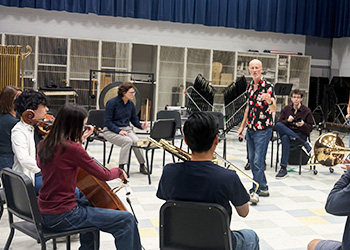
Orange, Calif. — Recovering stroke patients from UCI Health will soon benefit from dynamic, music-focused rehabilitation sessions based on “Strokestra,” a program created by the Royal Philharmonic Orchestra (RP0) over two decades ago.
Last week, UCI Health once again hosted professional musicians from the London-based orchestra who had previously visited in 2024, including Tim Steiner, the creator and director of “Strokestra.”
The week-long residency and workshop was a collaboration between the SeniorHealth Center and the UC Irvine Center for Medical Humanities, Claire Trevor School of the Arts and School of Medicine, whose support made the project possible.
"Members of the RPO have developed an incredibly innovative program which is implemented both in the community and hospitals for patients recovering from stroke. It’s a way to involve our stroke patients in creating and playing music; to help recover some of the function which has been lost, in a very targeted way through playing instruments," says UCI Health geriatrician Dr. Lisa Gibbs, who has led efforts over the past two years to establish a local version called “Harmonizing Healing.”
"When somebody suffers a stroke, part of their brain is injured but soon after the event, the brain focuses on healing … it lays down new pathways to relearn what has been lost. Music is a way to optimize that ability," she says.
“The program provides a holistic experience involving cognition, motor movement, sensory experiences and emotions while learning in a community of musicians, clinicians and stroke survivors."
Campus collaboration
This time around, clinicians from the Division of Geriatric Medicine and Gerontology and students from the Medical Humanities and Arts Program (MHAP) in the UC Irvine School of Medicine gathered with music students and faculty from the Claire Trevor School of the Arts to learn the innovative, music-based interventions for stroke patients.“One of the most exciting things about working in an orchestra is the process of rehearsing and making music together. It’s not just about what you see in the performance,” says Geoffrey Pope, DMA, director of orchestral studies at UC Irvine Claire Trevor School of the Arts, another key player in the program’s development.
“This program makes the musicians think about what it means to be inside the creative process, not rehearsing a piece of music that’s been pre-composed, but joining with stroke patients and each other in creating something new. It’s a very internal process but also a very communal process and unlike what we normally do,” he adds.
Playful patient workshop
As part of the training, stroke patients were able to participate in a mock workshop, where they played instruments, improvised and created music alongside the Royal Philharmonic’s world-class musicians and UC Irvine music students and faculty.
Then they took the show on the road, entertaining stroke patients in their rooms at UCI Health — Orange as well as delighting people in the lobby with a half hour jam session.
“I think one of the most powerful things about 'Strokestra' is that it's a really joyful thing and something stroke survivors and their caregivers do together which is therapeutic both physically and cognitively and in terms of well-being,” says Steiner. “The impact on patients and families has been extraordinary.”
Fourth year medical student and violinist Zoe Adams agrees.
“This experience is truly a humanizing thing and that’s why I got into healthcare in the first place — to support and understand and care for other people. I hope to carry this with me for the rest of my training, to never forget these special moments and really enjoy connecting with my patients as fellow human beings.”
Pilot program begins later this year
The Harmonizing Healing pilot program, scheduled to launch this November, is funded by the UC Irvine School of Medicine’s Medical Humanities and Arts Program (MHAP), which integrates medicine, humanities and the arts to explore their role in reimagining whole-person care.
“I’m always looking for opportunities for our students and other professionals to collaborate in music and art,” says Juliet McMullin, PhD, professor emeritus in the Family Medicine program, Johanna Shapiro Endowed Chair for Medical Humanities and Arts, and director of MHAP.
“When Dr. Gibbs brought me this opportunity, I knew it could help our students understand what music can do for the whole body and how to observe and listen to patients carefully while working with others and building empathy — and that’s how we support amazing healthcare professionals.”
“Under Dr. McMullin's direction, we'll conduct our own pilot six-week series for patients here at UCI Health later this year,” says Gibbs, who holds the Ronald Reagan Endowed Chair of Geriatric Medicine and serves as chair of the UC Irvine School of Medicine Department of Family Medicine.
“We want to study how this improves our patients’ health and outcomes, not only for themselves but also for their caregivers. After that, we hope to establish a sustained program here at UCI Health."
Playing and listening to music triggers the entire brain and we're just starting to scratch the surface of science to see exactly what's going on and why music has such recuperative powers, she adds.