




Cycling past cancer
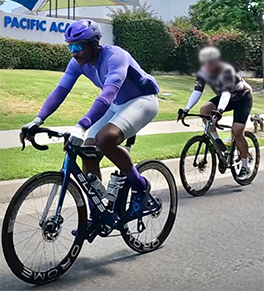
Blake Hoard loves to cycle. Each week, the Adelanto resident rides about 60 or 70 miles with a local club.
When his lower back began hurting in early 2024, he attributed the pain to his regular rides. A local orthopaedic surgeon didn’t find anything concerning and told Hoard that he likely had an age-related bulging disc. Regular back adjustments by a chiropractor didn’t help.
On Oct. 2, 2024, after telling his cycling group that he'd be taking a three-week break to rest his back, he fell in his garage in excruciating pain.
Hoard went to a nearby emergency room, where he received a CT scan, various tests and medication for his pain. There, a doctor told him that he had stage II multiple myeloma, a life-threatening blood cancer.
“I asked her what she meant," he recalls. "She told me that it had progressed to my spine. I remember telling her that she must be mistaken — I’m healthy and ride my bike multiple times a week.”
While evaluating his treatment options, Hoard traveled out of state for a family gathering. While there, a back spasm landed him in the hospital. After he was released, his health began to deteriorate. In a matter of weeks, he lost 30 pounds.
By Oct. 23, he had been referred to UCI Health orthopaedic surgeon Dr. Russell N. Stitzlein. He was told to go immediately to the UCI Health Chao Family Comprehensive Cancer Center for care.
Three surgeries in a month
Following several X-rays and tests, Stitzlein determined that Hoard would need a titanium rod inserted in his right leg to help stabilize his spine, which had been weakened by the cancer, putting him at risk of fracture. The surgery was done successfully the next day.
During his hospitalization after the procedure, a physical therapist discovered that the myeloma had progressed to his left leg and hip, weakening that side of his body, too. Within two weeks, he had two more surgeries: a titanium rod inserted in his left leg and hip along with three screws in his upper back.
“I stayed in the hospital for about three months recovering from surgeries and getting chemotherapy to help manage my multiple myeloma,” Hoard says. After he was discharged, he completed a course of radiation treatment.
As he recovered, he slowly resumed short bike rides and learned that he was a good candidate for an autologous stem cell transplant — using his own stem cells — to deepen his response to treatment.
Stem cell therapy offers hope
Stem cell transplantation is a standard treatment for multiple myeloma, especially for patients who are in good health, according to the American Cancer Society. Hoard fit the bill.
UCI Health is home to Orange County’s first adult bone marrow transplant program. Known as the Hematopoietic Stem Cell Transplant and Cellular Therapy (HSCT) Program, it also gives patients access to many advanced clinical trials as well as standard-of-care cellular therapies.
“Blake’s positivity throughout this cancer journey is so inspiring,” says Dr. Piyanuch Kongtim, a hematologic-oncologist and associate director of the HSCT program.
“He brings a smile to my face at every appointment, especially when he tells me about his upcoming cycling trips. He completed a road race in Mexico before his transplant!”
Transplant in new hospital
The 50-mile race behind him, Hoard became one of the first patients to receive a stem cell transplant at the new UCI Health — Irvine hospital shortly after it opened in December.
There, he was infused with his own bone marrow stem cells, which had been harvested the previous August in a procedure called apheresis. During the outpatient procedure, his blood was filtered through a special machine to separate blood-forming stem cells then returning the remaining blood to his body.
The transplant procedure, itself, felt like a brain freeze that affected his whole body, Hoard recalls. To protect him while his immune system repaired itself, he stayed in the hospital's transplantation unit for two weeks and couldn’t have visitors.
This dedicated unit is equipped with a special air filtration designed to protect people with weakened immune systems, making it safe for Hoard to walk the corridors for 30 to 40 minutes each day to stay active. He also exercised daily on a small, portable pedal machine.
After he was discharged, he continued to use his pedal machine and walk outdoors wearing a mask.
A return to cycling
By early 2026, Hoard was back on his indoor stationary bike, training with the goal of being road-ready in three months.
Once he was cleared to cycle outdoors, he slowly worked his way up to his regular 60- to 70-mile rides. He also started playing table tennis.
His latest tests showed no evidence of cancer.
“Dr. Kongtim recently told me that I’m in deep remission and that is because of UCI Health,” says Hoard, who will have his blood checked again near the end of the year.
Raising funds for others
Hoard is now training for the 10th annual UC Irvine Anti-Cancer Challenge on Oct. 10, 2026. The county's premiere cycling event raises awareness and donations for critical cancer research at the cancer center and Rady Children’s Health, formerly Children’s Hospital of Orange County (CHOC).
Since 2017, more than 20,000 participants have registered to ride, run and walk at the event, raising more than $7.8 million for trailblazing research at the first and only National Cancer Institute-designated comprehensive cancer center based in Orange County. The research made possible by those funds has generated over $80 million in external grants and support.
"I never gave up and look where I am today,” Hoard says. “I recently won two medals at a table tennis tournament, which I wouldn’t have been able to do three years ago!”
Register today for the UC Irvine Anti-Cancer Challenge.