




Early detection helps retiree fight prostate cancer
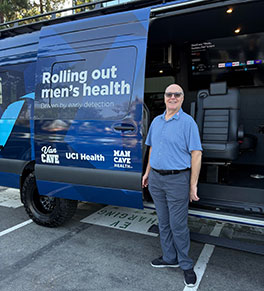
Michael Brill and his wife, LeeAnn, were volunteering at the UC Irvine Anti-Cancer Challenge last October when she noticed the UCI Health prostate screening lab-on-wheels dubbed the Van Cave parked nearby.
Brill had his annual a prostate-specific antigen (PSA) test barely six months earlier during a primary care checkup in Las Vegas, where the retired pharmacists live, the results were in the normal range.
But seeing the Van Cave screening station across from their volunteer booth on the university campus in Irvine, LeeAnn Brill had a nagging feeling that he needed another test. A survivor of two bouts of breast cancer thanks to her UCI Health doctors, she listens to her gut.
A reluctant Michael Brill walked over to the van, the first mobile prostate cancer screening unit of its kind. It was designed in partnership with Man Cave Health to provide PSA testing, early detection and education about the disease. Several phlebotomists were seated at tables under a canopy.
“I sat down and just like that, they drew my blood,” says the 70-year-old Brill. “It was quick and easy. Within a month, the results came back at 3.7. Six months earlier, it was 3.1 — that was a big jump!” (A reading below 4 is usually considered normal for a healthy man of his age.)
Results reveal risk
About a month later, he received a letter from UCI Health urologist Dr. Mohammed Shahait informing him that the PSA test results, combined with his family history, indicated that he had a 16% risk for prostate cancer. Shahait recommended additional testing.
“That jump, coupled with my brother being diagnosed with prostate cancer at 70 — and I was about to turn 70 — I figured I should do something,” Brill says.
In early February, when Brill met with Shahait, he explained that his older brother had radiation treatment for prostate cancer six years earlier and that his eldest sister had recently died of ovarian cancer. Having two first-degree relatives with cancer and spikes in his PSA levels over the previous two-year period warranted further evaluation, the urologist told him.
First came an MRI conducted by a team of fellowship-trained radiologists who specialize in genitourinary diseases. The imaging exam detected several suspicious lesions throughout the walnut-sized prostate gland.
Next, Brill had an MRI-guided transperineal biopsy, a state-of-the-art technique that enables the sampling of tissue throughout the prostate and has a lower risk of infection than the standard transrectal approach. The UCI Health Comprehensive Prostate Cancer Program is among fewer than 10% of U.S. cancer centers offering this biopsy technique, Shahait says.
Weighing treatment options
Of 15 tissue samples biopsied, eight came back positive for cancer, Brill recalls. “Anything over 50% of samples being high scoring meant that we had to decide whether to go with active surveillance, because I was still relatively young and didn’t have any health issues, or have surgery or radiation.”
Although his early-stage cancer had not spread beyond the prostate, Brill decided that active surveillance was out of the question. Radiation therapy at the UCI Health Chao Family Comprehensive Cancer Center could involve two months of treatment, five days a week, requiring him to stay in Orange County, an expensive proposition for the retired couple.
A third alternative was a robot-assisted prostatectomy to remove the prostate gland. Brill knew that Dr. David I. Lee, director of the prostate cancer program and one of the top prostate surgeons in the nation, had developed a nerve-sparing technique that has enabled a great many of his patients to retain sexual function and urinary continence.
“I saw Dr. Lee for the first time on May 8,” he says. “He was very compassionate, and answered any question I asked. I didn’t have to think twice. We scheduled the surgery right there for June 22.”
Eating fish tacos by lunchtime
 Brill is still amazed at how easy the experience was.
“It was very impressive, quick. I had the surgery at 7:15 in the morning, was in recovery by 9:30 and we left the surgery center a little after noon. By 1 p.m., I was eating fish tacos in the hotel restaurant. It was like nothing happened.”
Right after the procedure, the surgeon told LeeAnn he was confident that he’d gotten all the cancer.
On July 1, when the catheter that had helped him urinate while recovering from surgery was removed, he also got the pathology report. It showed no evidence of cancer cells in the surrounding tissue or seminal vesicles. The lymph nodes Lee removed for testing were also negative.
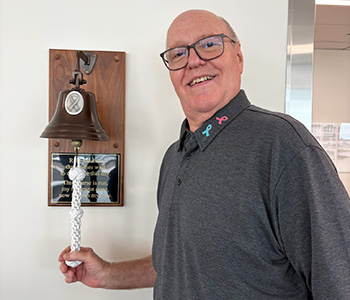
As his wife cried tears of joy, a grinning Brill rang the bell in the Chao Family Comprehensive Cancer Center in Irvine, signaling to everyone within earshot that he was cancer free.
He will return every three to six months for the next few years for tests to detect any sign of recurrence, a risk the surgeon says is low. He’ll also participate in Lee's ongoing study of his more than 7,500 prostatectomy patients. In addition, he has been referred to a UCI Health genetic counselor to test for inherited cancer-related genes.
The Van Cave, a community resource
”I’m very glad I chose surgery,” Brill says. “If I’d undergone radiation, it would always be in the back of my mind, was the cancer completely gone? Now I know it is done, taken care of. And I got this great outcome.”
He is also grateful for his wife’s gut feeling — and the Van Cave, which gave him easy access to vital PSA testing that help detect the disease early.
“Prostate is a big cancer for men and a lot of men tend to put off getting tested,” he says. “The Van Cave can raise awareness about the disease and bring those tests to you.”
The Van Cave is expected to be on hand at a number of UCI Health-sponsored events this fall. Email urology@hs.uci.edu to learn more about the men's health laboratory on wheels.
"I'm so happy I was proactive," Brill says. "I can go on and live my life normally and be there for LeeAnn."
For more information about prostate cancer and prostate cancer screening or to seek a second opinion, call 714-456-7005.