




Pancreatic cancer survivor savors life
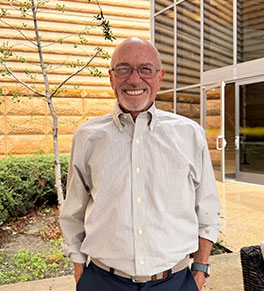
“That I’ve lived beyond six months is a gift,” says pancreatic cancer survivor Cal Lockett, who looks forward to his son's wedding in June 2027. “That gift came from all the incredible UCI Health doctors, healthcare providers and nurses."
Newly retired, Cal Lockett set out for Rome in early January 2025 to fulfill a lifelong dream: to study his Catholic faith and volunteer at the Vatican.
Little did he know that he would undergo surgery for pancreatic cancer a year later at UCI Health, where a team of specialists at the Chao Family Comprehensive Cancer Center are dedicated to helping patients like Lockett beat the deadly disease.
Pancreatic cancer is the third leading cause of U.S. cancer deaths with a five-year survival rate of 13%.
“If I had stayed with the original doctors I met with first, I would have been gone by now,” says the 68-year-old Indio resident, whose recent tests show no evidence of cancer.
During Lockett’s six-week sojourn in Rome, he began experiencing abdominal pain. Back home in late February, his symptoms got worse. Eventually, he went to a Coachella Valley gastroenterologist, who ordered tests to find the cause of his pain and difficulty eating.
A suspicious growth
In May, after a scan showed a suspicious growth on his pancreas, he met with a community oncologist. While awaiting biopsy results, the doctor said the mass was probably pancreatic cancer. With chemotherapy, she said she could keep him alive for a year and possibly shrink the tumor enough to make surgery a possibility.
However, a gastrointestinal (GI) cancer surgeon he met with a few days later said the tumor’s location, wrapped around his main abdominal artery, made him an unlikely surgical candidate.
“He said I should start getting my affairs in order,” Lockett recalls. “Basically, I had been given a death sentence even before they had confirmed the diagnosis.”
A second opinion
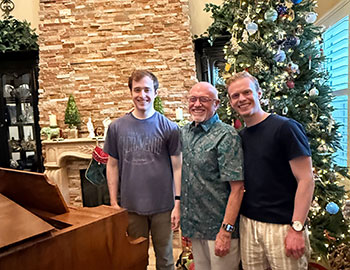
Thinking of his two sons — one about to graduate from an Iowa university, the other just finishing a master’s degree program in Washington, D.C. — Lockett sought a second opinion from another Coachella Valley oncologist who was far more optimistic.
“We have the latest technologies and I can help you get rid of the cancer with chemotherapy,” the second oncologist told him. “In the meantime, I want you to see a surgeon at UCI Health.”
That surgeon was Dr. Zeljka Jutric, chief of hepatobiliary surgery at the UC Irvine School of Medicine and the UCI Health Chao Digestive Health Institute. She is an integral part of the multidisciplinary pancreatic cancer team.
“Dr. Jutric was just so optimistic and excited about helping me out,” Lockett says. “She put together a plan and started working with my oncologist to make sure the timing of my chemotherapy was right for surgery. Every time I got scans, she would follow up.”
Jutric also sent Lockett to UCI Health interventional radiologist Dr. Nadine Abi-Jaoudeh, who had recently launched a potentially groundbreaking clinical trial to attack pancreatic tumors like his.
Innovative therapy to destroy tumors
The first-in-human, phase 1 clinical trial uses laser light to activate the light-sensitive drug Padeliporfin to destroy pancreatic tumors that encase major abdominal arteries. Once the blood vessels are clear of tumors, patients can undergo what can be lifesaving surgery.
UCI Health is the first of only two U.S. cancer centers to test the treatment, called vascular targeted photodynamic therapy (VTP) with Padeliporfin.
Abi-Jaoudeh told him he’d be a good candidate for the trial after completing chemotherapy. However, since the tumor was large and attached to two blood vessels, she recommended VTP on one vessel followed by targeted radiation on the other.
After completing 13 rounds chemotherapy, Lockett underwent VTP treatment then targeted radiation therapy in December 2026.
Complex surgery successful
In late January 2026, a team of surgeons led by Jutric removed the tumor, his pancreas, spleen and gall bladder, along with a third of his colon during a 13-hour surgery. The surgery involved meticulously dissecting, or removing, the tumor from several blood vessels, followed by reconstruction of one of the body’s most important blood vessels.
“Dr. Jutric had a big smile on her face when she came to tell me that she was able to get all the cancer, which is pretty unusual,” Lockett says. “She wouldn't have been able to do that without the clinical trial.”

After a few days in the hospital for observation, Lockett went home to recover. Soon, he developed a complication that led to his abdomen filling with lymphatic fluid. He was transported by ambulance to UCI Health — Orange, where he was infused with a chemical to detect the source of the leakage. Although the source was not found, the leaking stopped, which can happen sometimes with the chemical infusion, says Abi-Jaoudeh.
When Lockett was released from UCI Health a second time, on Easter Sunday 2026, he had lost nearly 60 pounds and was so weak that he needed a walker to get 10 feet to the bathroom.
“Within two weeks, I was climbing the stairs,” he says. “I was working out at the gym about a month later. I know my body is still recovering and I'm not 100%, but I’m definitely feeling better every day. Dr. Abi-Jaoudeh and Dr. Jutric saved my life.”
Focused on the future
Nearly a year after surgery, Lockett’s latest blood tests show no evidence of cancer markers. His imaging scans have also been clear.
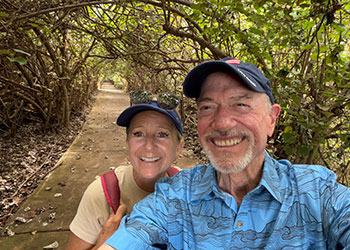
“Seeing patients like Cal get back to living their lives is what this work is all about,” Jutric says. “Cal is a special person, and it has been a privilege to walk this road with him. These surgeries are some of the most complex we do, and seeing him thrive is deeply rewarding. I’m proud to be part of a UCI Health team that is innovative and committed to changing what pancreatic cancer means for patients.”
Lockett has gained more weight and returned to gardening and cooking. He also hopes to resume deep sea diving. Most of all, he looks forward to his elder son’s wedding in June 2027.
“That I’ve lived beyond six months is a gift,” he says. “That gift came from all the incredible UCI Health doctors, healthcare providers and nurses — these caring people who are so excited about new opportunities to save people's lives.
“I’m living proof that pancreatic cancer can be beaten.”
The VTP clinical trial is one of more than a dozen leading-edge pancreatic cancer studies offered by the Chao Family Comprehensive Cancer Center, the only National Cancer Institute-designated comprehensive cancer center based in Orange County and one of only 58 in the country.
To learn more about UCI Health Pancreatic Cancer Services or schedule a consultation, call 714-456-8000.
Related stories
- Young dancer triumphs over rare pancreatic tumor ›
- First-in-human study attacks pancreatic tumors with laser light ›
- UC Irvine-led study identifies promising target for pancreatic cancer that spreads to the liver ›
About the UCI Health Chao Family Comprehensive Cancer Center
The Chao Family Comprehensive Cancer Center, recently ranked No. 30 in the nation by U.S. News and World Report, is the only National Cancer Institute-designated comprehensive cancer center based in Orange County. It provides access to the most innovative treatments for every type of cancer, including more than 500 clinical trials. Many of those are early-phase trials are initiated by UCI Health clinicians and scientists who are at the forefront of cancer research. Such pioneering work is a central mission of the cancer center and a hallmark of the academic medicine offered by UCI Health, the only academic health system in Orange County. The cancer center serves patients in Orange County, the sixth most populous U.S. county, and much of Riverside County and southeast Los Angeles County. But fully a third of its patients come from across Southern California and the United States.