




Grateful mom fights lung cancer, for herself and others

When Kimberly Thorp was diagnosed with advanced lung cancer, her daughter was 2 years old. Today, she is 6. Those four years are more than a measure of Thorp’s survival.
They have been filled with birthdays, school milestones, family trips and ordinary days together — time made possible by research, targeted therapy and UCI Health lung cancer oncologist Dr. Misako Nagasaka, who kept searching for the best path forward.
That experience is why Thorp and her husband, Dan, have supported the UC Irvine Anti-Cancer Challenge since 2022.
The Anti-Cancer Challenge was founded in 2017 by Dr. Richard A. Van Etten, director of the UCI Health Chao Family Comprehensive Cancer Center, the only National Cancer Institute-designated comprehensive cancer center based in Orange County and one of only 58 in the country.
Now in its 10th year, the run-ride-walk event has raised more than $9 million to support the research efforts of the cancer center's clinicians and scientists.
Paying it forward
For last two years, the couple’s philanthropy has fully funded research led by Nagasaka. Their goal is to help support studies that will give hope to other lung cancer patients and their families.
“UCI Health has given so much to us that we want to pay it forward,” says Dan Thorp. “The Chao Family Comprehensive Cancer Center is committed to beating cancer, not just treating it. They are in it to win it.”
Kimberly Thorp had always considered herself healthy. She exercised regularly, never smoked and was careful about what she ate. The couple split their time between Henderson, Nev., and Park City, Utah, enjoying an active family life with their young daughter.
In the summer of 2022, Kimberly sought emergency care after becoming seriously ill following a family trip. Imaging at the Utah emergency department revealed fluid surrounding her lungs and heart.
Doctors drained more than a liter of fluid from the sac around her heart alone. A nurse told her that amount of fluid should have caused her heart to stop.
Cancer cells were found in the liquid and additional imaging showed a 4.8-by-2.3-centimeter mass in the lower lobe of Kimberly’s left lung. She was diagnosed with stage IV non-small cell lung cancer.
Lung cancer is the leading cause of U.S. cancer deaths in men and women. Despite its association with tobacco use, one in five women diagnosed with lung cancer have never smoked. Fewer than 10% of people diagnosed with late-stage lung cancer survive five years.
Stunned by unexpected diagnosis
“I didn’t know how to process this,” Kimberly recalls. “There are a lot of misconceptions and negativity associated with people who have lung cancer.”
Kimberly and Dan immediately sought consultations with leading U.S. lung cancer specialists. At the first cancer center they visited, the doctor offered one standard treatment option and told her she probably had three years to live.
“The whole meeting was really negative, downbeat,” remembers Dan. “It was like a foregone conclusion that she would die. Everything they described left us dejected and feeling doomed.”
A friend made an appointment for Kimberly at the Chao Family Comprehensive Cancer Center. By the time they arrived, she was so weak that she needed a wheelchair to navigate the airport.
Finding an advocate
When Kimberly met Nagasaka, she was struck by the difference in the oncologist's approach The doctor was focused not only on the severity of the diagnosis, but also on understanding the biology driving the cancer — and finding a treatment most likely to work for her disease.
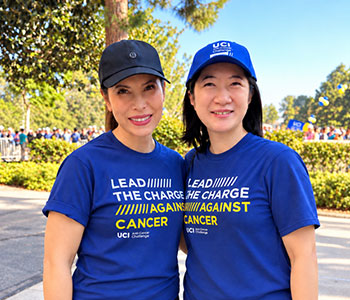
“Having cancer is stressful enough,” Kimberly says. “It means everything to have somebody be your advocate, helping you navigate things, laying out the options — and never treating you like you’re death walking, or just another number.”
Molecular testing identified a genetic mutation called an EML4-ALK fusion that drives a subset of non-small cell lung cancers. That opened the door to two highly effective targeted therapies, presenting her with a difficult decision.
One expert had strongly recommended alectinib, an established first-line ALK therapy. But Nagasaka proposed a newer-generation ALK inhibitor called lorlatinib. Kimberly and Dan were deeply conflicted over which treatment to choose and worried about how that decision might affect future options.
Instead of asking Kimberly to accept her recommendation, Nagasaka connected her with a lung cancer specialist in Nashville, Tenn., who was internationally recognized for her work in ALK-positive lung cancer.
Kimberly was again impressed by Nagasaka’s approach to her care. Her priority wasn’t keeping every aspect of Kimberly’s treatment at UCI Health. Instead, the doctor sought the best information and the right expertise wherever it could be found, then she helped Kimberly and Dan understand their options in order to make decisions with confidence..
A spectacular response
Kimberly ultimately went with Nagasaka’s recommendation and began treatment with lorlatinib on Aug. 5, 2022. The response was rapid. At her two-month PET scan on Oct. 5, 2022, The nodule had shrunk by 75%. In December, scans showed what the cancer center’s multidisciplinary tumor board characterized as a "spectacular response" to targeted therapy.
That suddenly opened up a rarely considered potential therapy for patients with stage IV lung cancer: treating what remained of the primary lung tumor locally with surgery, radiation or ablation.
Again, Nagasaka looked beyond institutional boundaries. She coordinated multidisciplinary opinions to evaluate those options, then helped identify a thoracic surgeon with experience in unusual cases like Kimberly’s.
On Feb. 22, 2023, a thoracic surgeon removed the lower portion of her left lung. The pathology report found no viable cancer cells in the resected lung tissue.
Later in 2023, doctors discovered an almond-sized lesion in her brain. She had a five-day course of focused radiation at the cancer center in Orange, while continuing targeted therapy. Subsequent imaging showed no progression or new lesions.
Radiation led Kimberly to lose all the hair at the top of her head. She was told it would not grow back in the area where the lesion was treated. However, after undergoing scalp microchanneling therapy, she has experienced hair regrowth — a meaningful part of her recovery.
Kimberly has continued lorlatinib treatment, which has required dose adjustments to balance side effects with her quality of life. Nagasaka continues to coordinate her care and monitor her closely with CT scans and brain MRIs. Her latest scans have shown no progression of disease.
What research gave their family
For Kimberly and Dan Thorp, research is not an abstract concept. The treatment that changed the course of her disease exists because scientists, physicians, patients, participants in clinical trials and donors invested in research to understand the molecular drivers of cancer and develop therapies to target them.
When Kimberly was first diagnosed, she was terrified that she wouldn't be able to watch her daughter grow up. Being able to share simple moments and life experiences with her child over the last four years has spurred her to continue supporting Nagasaka’s research.
“Other people gave their time and resources and they participated in clinical trials so that treatments like mine could exist,” Kimberly says. “Research has given me time with my daughter. Supporting research is our way of helping give that possibility to someone else.”
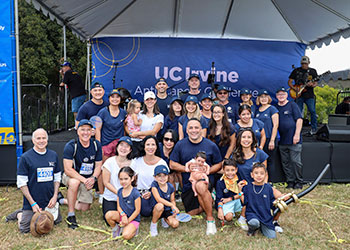
Both Kimberly and Nagasaka were honored at the 10th annual UC Irvine Anti-Cancer Challenge in October. Kimberly’s family and friends joined them to celebrate how far she has come. More importantly, her team, Kim’s Cancer Crushers, helped raise funds for research that can move cancer treatment forward.
“I am so blessed and so grateful to Dr. Nagasaka and the entire UCI Health team,” Kimberly says. “We’ve gotten to know the doctors and seen them all in action. We know their hearts are in it. This is about helping and saving others, like they’ve done for me.”