




UCI Health physicians honored as Rising Stars in infectious disease treatment and prevention
Dr. Shruti K. Gohil, Dr. Erlinda Ulloa honored for infectious disease research leadership, impact on patient care
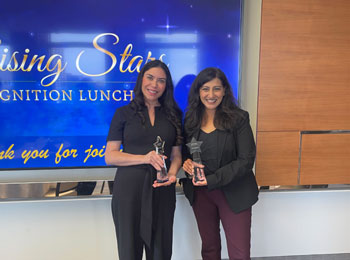
Orange, Calif. — The World Health Organization has reported that deaths from antibiotic resistance could top cancer deaths by 2050, an estimate that concerns Dr. Shruti K. Gohil and Dr. Erlinda Ulloa. As infectious disease specialists at UCI Health and in the UC Irvine School of Medicine, they are determined to prevent this from becoming reality.
“Overuse of antibiotics, specifically in the hospital, is a major problem,” says Gohil, “so over the last two years, my work has centered on changing the way we use antibiotics.”
Ulloa’s concerns focus on pediatric care. “When a child comes to us with an infection that is resistant to every antibiotic we’ve tried, families are terrified and clinicians feel helpless,” she says. “My work is about expanding those options — finding new ways to make existing antibiotics work better, discovering drug combinations that can overcome resistance, and developing testing methods that help us choose the right treatment faster.”
In recognition of their infectious disease research and impact on patient care, both were named recipients of the Fall 2025 Rising Star Award.
Dr. Shruti K. Gohil pushes for sea change
Gohil is calling for a “sea change” when it comes to antibiotic resistance. “We really need to change the landscape of prescribing antibiotics to curb what we think will be a rising crisis in 2050.”
In a series of four randomized controlled trials — the INSPIRE trials — Gohil led the evaluation of a tool she developed to help physicians better identify patients in need of broad-spectrum antibiotics. “We created prompts in the electronic health record system to see if we could influence physician behavior related to choosing broad-spectrum antibiotics.”
She explains that the current paradigm is to start with broad-spectrum antibiotics, particularly when treating pneumonia, urinary tract infections, abdominal infection, and skin and soft tissue infections.
“This leads to 40% to 50% of patients getting broad-spectrum antibiotics when they don’t really need them,” she says, “increasing a patient’s risk for not only antibiotic resistance but also for kidney toxicity, liver toxicity and a future microbiome hit.”
Findings show that the tool reduced broad-spectrum antibiotic overuse by up to 35%. Furthermore, prescribing the most low-risk antibiotics didn’t worsen patient outcomes. “We were able to address fears of under-treating a patient, because the safety outcomes were the same,” she says.
In addition to antibiotic resistance, Gohil has also studied bloodstream infections stemming from central lines.
“When we put patients on medications that require a long IV that goes into the heart, this piece of plastic puts patients at a high risk for infection,” she says. These lines are closely monitored while patients are in the hospital, but risks increase when patients return home. “We need a mechanism by which we can still evaluate the line to prevent infections. This has been a gap in the field.”
So Gohil helped develop a scoring system and a mobile app to evaluate the line daily through uploaded photos. The app is called Standardizing Assessment For Effective Response (SAFER) Lines. “The SAFER Lines app is programmed to automatically alert a physician if there is cause for concern,” she says. Findings from a study found that the app resulted in a 28% reduction in localized infection and a 41% reduction in rehospitalizations.
Gohil was pleased to have her work recognized with the Rising Stars Award.
“I was humbled because UC Irvine is full of such bright, intelligent, forward-thinking people,” she says. “I’m grateful to be here, and to have such strong support. The U.S. healthcare system is top-notch and academic research is a big part of that.”
Dr. Erlinda Ulloa offers new options
Ulloa’s research targets a critical gap in pediatric infectious diseases: caring for children with severe, drug-resistant infections where standard therapies fail or don’t exist.
“By linking laboratory discovery with clinical challenges, my team develops solutions, from improved antimicrobial testing to immune-enhancing strategies and novel drug combinations,” she says. “Our goal is simple but urgent: equip clinicians with better tools and support families when they have few remaining options.”
One of Ulloa’s most significant contributions challenges how antibiotics have been tested for more than 80 years.
“Clinical laboratories evaluate antibiotic effectiveness using nutrient-rich conditions developed in the 1940s,” she explains, “but these tests don’t reflect what actually happens inside the human body.”
Her research has revealed something remarkable: antibiotics dismissed as “ineffective” by traditional testing can actually be powerful weapons against drug-resistant bacteria when tested under physiologically relevant conditions.
“We found that azithromycin, often written off as useless against multidrug-resistant bacteria, shows potent activity when tested under conditions that mimic the human body,” says Ulloa. “It enhances immune-mediated killing and disrupts biofilm formation.”
This discovery has profound implications. Ulloa’s team is developing a breakthrough technology that could transform antibiotic testing. “We are combining bacterial metabolic profiling with machine learning to deliver clinically actionable results within hours, far faster than the 16 to 24 hours required by current methods,” she says. “Our approach evaluates bacterial responses under both standard and physiologically relevant conditions, helping clinicians determine which antibiotics are likely to be effective in individual patients.”
Ulloa has also tackled one of the deadliest challenges in infectious disease: persistent Staphylococcus aureus bloodstream infections. Her studies showed that adding carbapenems to standard anti-staphylococcal antibiotics like cefazolin can clear persistent bacteremia within 24 hours in patients failing conventional therapy. It was a breakthrough that received international attention, including coverage in NEJM Journal Watch.
“Carbapenems enhance the patient’s immune response while disrupting protective bacterial biofilms,” she explains. This approach is now being expanded to MRSA and other resistant staphylococcal pathogens.
Ulloa loves her work in infectious diseases, finding it both intellectually challenging and deeply impactful.
“Every case is a puzzle that draws on science and clinical insight,” she says. “Taking questions inspired by my patients to the lab and returning discoveries to improve their care is what makes this work so meaningful.”
Ulloa has seen firsthand how laboratory discoveries can save lives. When a young cancer patient developed debilitating calciphylaxis — a rare, devastating condition with no proven therapies — complicated by a skin infection resistant to all available antibiotics, the team in the Ulloa Lab worked around the clock to develop a solution.
“Ultimately, we secured FDA emergency approval for novel therapies, including the first use of cefepime-zidebactam in the United States and the first clinical use of phage therapy at our children’s hospital,” says Ulloa. “That’s the power of translational research: turning scientific discoveries into therapeutic solutions for children.”
She was honored to receive the Rising Stars award.
“It is an incredible honor that also reflects the dedication of my team who make this work possible,” she says. “This recognition reinforces my commitment to pushing the boundaries of what’s possible in treating drug-resistant infections, so when standard therapies fail, patients have options.”
— Shani Murray
Originally appeared on the UC Irvine School of Medicine website.
About UCI Health
UCI Health is one of California’s largest academic health systems and the clinical enterprise of the University of California, Irvine. Established on July 1, 1976, UCI Health has grown into a 1,513-bed health system that includes UCI Health — Orange, UCI Health — Irvine, its newest facility, UCI Health — Irvine Rehabilitation Hospital, four Community Network hospitals and a growing network of ambulatory care centers across Orange and Los Angeles counties. As Orange County’s only academic health system, UCI Health is home to the only National Cancer Institute-designated comprehensive cancer center based in the county, the region’s only American College of Surgeons-verified Level I adult and Level II pediatric trauma center, American College of Emergency Physicians Gold Level 1 Geriatric Emergency Department and a nationally recognized regional burn center verified by the American Burn Association. Powered by UC Irvine, UCI Health serves 5.6 million people across Orange County, western Riverside County and southeast Los Angeles County through excellence in patient care, research and medical education. Follow UCI Health on Facebook, Instagram, LinkedIn and X.