




Pancreatic cancer program performs its first robot-assisted Whipple procedure
Complex minimally invasive procedure can reduce complications, speed recovery
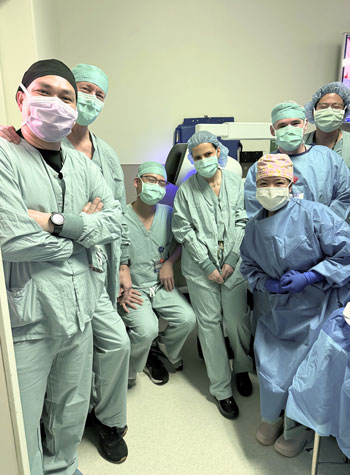
Orange, Calif. — The UCI Health Pancreatic Cancer Program has performed its first robot-assisted Whipple procedure, an important milestone for the program that advances its ability to provide the most advanced, skilled treatments for the condition.
The highly complex procedure was performed in January on a patient in their 20s with a 5-centimeter solid pseudopapillary neoplasm of the pancreas.
During the operation, UCI Health surgical oncologist Dr. Reed I. Ayabe removed the head of the pancreas, part of the small intestine, half of the stomach, the gallbladder and bile duct, followed by a reconstructive reattachment of the remaining organs.
Advantages of the robot-assisted Whipple
The potential advantages of the procedure, Ayabe says, include:
- Smaller incisions
- Lower hernia rates
- Reduced pain
- Faster healing and recovery
- Decreased blood loss
- Fewer blood transfusions
- Lower risk of infections
The oncologic outcomes are equivalent to those in open surgery, he notes.
Ayabe says that, for surgeons, the robot offers a couple of unbeatable benefits. It enables them to visualize the body’s structures much better than they could with the naked eye and allows for greater precision. It also enables surgeons to perform complex tasks such as suturing and fine dissection with both hands, providing ambidexterity that may not be present with open surgery.
“That’s part of the technology’s superpower.”
Ayabe notes that because of the high volume of Whipple cases done at UCI Health, surgeons there have the expertise and experience to provide superior outcomes.
Building the program
The milestone is the result of a year and a half of work developing the robotic hepatopancreatobiliary program at UCI Health, Ayabe says.
It required recruiting and training an expert team and implementing workflows that would ensure quality and patient safety.
“We started with simpler procedures, such as partial hepatectomies and distal pancreatectomies, before progressing to more complex operations like major liver resections and biliary reconstruction,” Reed says of the time leading up to the first Whipple using the robot.
The patient was a good candidate for the procedure because the tumor didn’t involve the vascular system. Ayabe says operating on such tumors with the robot will be the program’s next major milestone.
About UCI Health
UCI Health is one of California’s largest academic health systems and the clinical enterprise of the University of California, Irvine. Established on July 1, 1976, UCI Health has grown into a 1,513-bed health system that includes UCI Health — Orange, UCI Health — Irvine, its newest facility, UCI Health — Irvine Rehabilitation Hospital, four Community Network hospitals and a growing network of ambulatory care centers across Orange and Los Angeles counties. As Orange County’s only academic health system, UCI Health is home to the only National Cancer Institute-designated comprehensive cancer center based in the county, the region’s only American College of Surgeons-verified Level I adult and Level II pediatric trauma center, American College of Emergency Physicians Gold Level 1 Geriatric Emergency Department and a nationally recognized regional burn center verified by the American Burn Association. Powered by UC Irvine, UCI Health serves 5.6 million people across Orange County, western Riverside County and southeast Los Angeles County through excellence in patient care, research and medical education. Follow UCI Health on Facebook, Instagram, LinkedIn and X.