



Eye researchers at work on groundbreaking whole-eye transplant
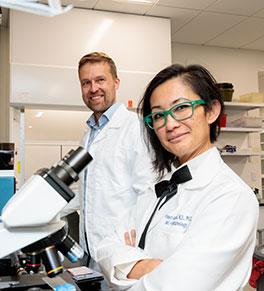
On the path to making an eye transplant possible, researchers Frans Vinberg and Dr. Kimberly Gokoffski, at right, expect what they learn along the way will result a myriad of advances in vision treatments.
The goal is simple but audacious: to restore vision with a whole-eye transplant. Across the country, research teams are racing to make that breakthrough, including UCI Health neuro-ophthalmologist Kimberly Gokoffski, MD, PhD, and vision scientist Frans Vinberg, PhD.
In 2024, the Advanced Research Projects Agency for Health* (ARPA-H) committed up to $132 million in federal funds for the Transplantation of Human Eye Allografts (THEA) program, which aims to find a cure for blindness by successfully transplanting a whole, functioning human eye. The agency, part of the U.S. Department of Health and Human Services, awarded funds to four consortiums composed of scientists from multiple institutions.
Gokoffski is part of the THEA research team based at the University of Colorado Anschutz Medical Campus; Vinberg is part of a team based at Stanford University’s Byers Eye Institute. Both Gokoffski and Vinberg are scientists with the eye institute and the UC Irvine Brunson Center for Translational Vision Research.
'Incredibly challenging'
“Whole-eye transplantation offers the advantage of being able to treat all causes of blindness,” says Gokoffski. “But it’s also incredibly challenging — some would say impossible.”
The first challenge is finding viable human eyes. Gokoffski and Vinberg work with organ donation centers like One Legacy, but healthy donor eyes are rare.
Once they find a usable eye, the organ’s light-sensing ability must be preserved long enough to transplant, a period of up to 48 hours. During transplant surgery, they have to restore blood flow to the donor eye from the recipient and reattach more than one million nerves that send messages from the eye to the brain to restore vision. Even if that is successful, doctors then must prevent the body’s immune system from attacking the donor eye.
Gokoffski, who joined UCI Health and the Department of Ophthalmology and Visual Sciences in 2025, specializes in eye-brain connection disorders, making her ideally suited to tackle the challenges of whole-eye transplant. As leader of a team of five scientific principal investigators/professors, she is involved in nearly every aspect of developing the novel transplant process.
Connecting a million nerve fibers
Her team is using unique electrical signals to guide each of the one million optic nerve fibers to connect to a specific receptor in the brain, like inserting tiny electrical plugs into the right socket. Otherwise, visual signals from the retina arrive garbled and out of place, like visual static or perhaps distorted like a Cubist painting.
Gokoffski is working with Dion Khodagholy, PhD, who specializes in bioelectronics at the UC Irvine Samueli School of Engineering, and Gianluca Lazzi, PhD, an expert in biomedical electromagnetics with the Keck School of Medicine of USC. They are developing a sophisticated electrode that would surround the optic nerve and steer nerve growth to the right places in the brain.
“What we’re doing is complementary to others who are trying to stimulate growth of the optic nerve,” Gokoffski says. “If you can have an external signal that says, ‘This is the direction I need you to grow in,’ that will be helpful. But it’s not going to be enough.
“There will have to be visual rehabilitation to train the brain of the transplant recipient. And that’s a big question: Can the brain be trained to work with this new eye?”
Preserving the donor eye
Meanwhile, Vinberg, an associate professor who joined the Department of Ophthalmology and Visual Sciences in January, seeks methods to preserve the donor eye’s function until it can be transplanted into a recipient. His previous research drew international attention when he proved that light responses — essential for sight — could be revived in donated human eyes.
For a glimpse of what’s possible, Vinberg and Gokoffski cite a landmark case in 2023, when New York doctors transplanted half of a face, including an entire eye, for a U.S. military veteran who had been injured in an electrical accident. While his vision was not restored, the eye remained intact, and it is a foundation to build on.
Despite the obstacles, they’re enthusiastic about how the THEA program has fueled collaboration across multiple institutions and accelerated the race to cure blindness, making discoveries along the way to improve vision care and neuroscience.
Says Vinberg, “Even before achieving whole-eye transplantation, itself, many things we’re learning through the process will help advance all kinds of vision therapies.”
* This research is funded in part by the Advanced Research Projects Agency for Health (ARPA-H). The views and conclusions are those of the authors and should not be interpreted to represent official policies, expressed or implied, of the U.S. government.